
Lombardi Formula: The Exponential 1RM Curve
The Lombardi formula estimates your one-rep max with an exponential curve: 1RM = weight × reps0.10. It’s the most conservative of the popular formulas once you get past about 8 reps, which makes it the one I reach for when someone hands me a high-rep set and asks what their max is. It won’t flatter you — and that’s the point.
What is the Lombardi formula?

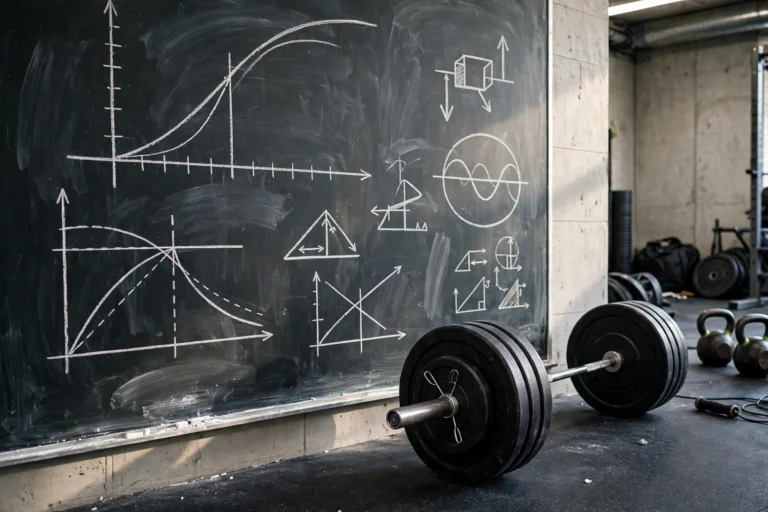
Published by Lombardi in 1989, it’s built on a power curve instead of a straight line. Where Epley and Brzycki draw roughly linear relationships between reps and percentage of max, Lombardi says each additional rep costs you progressively less — the curve flattens out. The practical upshot: at low reps it agrees with everyone else, but at high reps it refuses to keep climbing the way Brzycki does.
Put numbers on it. From 100 kg:
- 1 rep → 100.0 kg (perfectly honest — a single is a single)
- 5 reps → 117.5 kg
- 10 reps → 125.9 kg
- 15 reps → 131.1 kg
Now compare that 15-rep figure to Brzycki, which predicts 163.6 kg from the same set. That’s a 32.5 kg gap between two respected formulas looking at identical input. Somebody’s wrong, and for high-rep sets, the smart money is on Lombardi being closer to reality — Brzycki’s curve just keeps accelerating past the point where human physiology taps out.
How does the Lombardi math actually work?
The formula is 1RM = W × R0.10, where W is the weight lifted and R is the reps performed.
The exponent 0.10 is doing all the work. Raising the rep count to the 0.10 power means doubling your reps from 5 to 10 only bumps the multiplier from about 1.175 to 1.259 — a small move. That’s the flattening curve in action: Lombardi assumes there’s a ceiling to how much a high-rep set tells you about your single-rep strength, and the math enforces it.
One elegant property worth knowing: at exactly 1 rep, any number to the 0.10 power… well, 10.10 = 1, so the formula returns the weight itself. No formula should tell you your max is higher than a weight you actually lifted for one clean rep, and Lombardi never does.
Worked example: 100 kg for 5 reps
Step by step:
- Weight = 100 kg, reps = 5
- Compute 50.10 = 1.1746…
- 100 × 1.1746 = 117.46
- Estimated 1RM: 117.5 kg
And in pounds, since most of you think that way: 225 lb for 5 reps.
- 50.10 = 1.1746
- 225 × 1.1746 = 264.29
- Estimated 1RM: 264.3 lb
For context, Epley would give you 262.5 lb and Brzycki 253.1 lb from that same set. Lombardi sits right next to Epley here — at 5 reps all the formulas are still in the same neighborhood. They only start arguing past rep 8 or so.
Where does Lombardi shine?
High-rep sets. This is its whole reason for existing. If someone tells me they did 185 for 12 and asks for their max, Brzycki’s answer (roughly 232) smells like fantasy to me. Lombardi says about 206, which is still generous but at least lives in the same zip code as reality. When the input set is deep into endurance territory, Lombardi is the formula least likely to embarrass you.
Honesty at the bottom end. It never predicts a max below or weirdly above a true single. Some formulas get squirrely at 1-2 reps; Lombardi is rock solid there.
Programming conservatively. If you’re building training percentages off an estimate, a slightly conservative number keeps you in productive ranges instead of burying you under weights you can’t recover from. Lombardi-based training maxes are very livable.
Where does it struggle?
It can undershoot for “reppers.” Some lifters are genuinely good at high reps — their 12-rep set really does reflect a bigger max than Lombardi credits. If you know you’re that type (your tested max consistently beats Lombardi’s prediction), blend it with Epley or just trust your own calibration.
The mid-range is unremarkable. Between 3 and 8 reps, Lombardi doesn’t tell you anything Epley and Brzycki don’t. Its value is specifically at the extremes.
How does Lombardi compare to Epley and Brzycki?
At 5 reps from 100 kg: Epley says 116.7, Lombardi says 117.5, Brzycki says 112.5. Basically a rounding error between them — pick any one and move on.
At 10 reps: Epley and Brzycki agree exactly at 133.3, Lombardi says 125.9. Now there’s daylight — about a 7 kg gap.
At 15 reps: Brzycki 163.6, Epley 150.0, Lombardi 131.1. This is where the formulas stop being polite to each other. My read, backed by what actually happens on platforms: the truth for most lifters is closer to Lombardi’s end of that spread than Brzycki’s. Fifteen reps is an endurance set wearing a strength costume.
The honest approach, and the one our calculator takes: look at where several formulas land together instead of marrying one. When they agree (low reps), trust the consensus. When they diverge (high reps), trust the conservative end.
Frequently asked questions
Is the Lombardi formula accurate?
It’s as accurate as any formula in the 1–8 rep range, and more trustworthy than most above 10 reps because its curve flattens instead of inflating. No formula beats a well-chosen test set, though — 3 to 5 reps near failure is where all of them do their best work.
Why is Lombardi lower than Brzycki at high reps?
Different curve shapes. Brzycki’s formula accelerates as reps climb (the denominator 37−r shrinks), while Lombardi’s exponent flattens out. At 15 reps from 100 kg that’s 163.6 vs 131.1. Physiology favors Lombardi here — nobody’s 15-rep set predicts a max 63% higher.
Should I use Lombardi for deadlift estimates?
It’s a reasonable choice, with one caveat: every formula underestimates the deadlift by roughly 9–14% (LeSuer et al., 1997), Lombardi included. Whatever it tells you, your real pull probably runs a bit higher.
Who was Lombardi?
The formula dates to 1989 and is credited to Lombardi in the strength literature. It’s one of the seven equations LeSuer and colleagues tested head-to-head in their 1997 validation study, which is the main reason it survived while dozens of other formulas faded.
Sources
- LeSuer, D.A., et al. (1997). The accuracy of prediction equations for estimating 1-RM performance in the bench press, squat, and deadlift. Journal of Strength and Conditioning Research, 11(4), 211–213.
Learn more