
Bench Press Calculator Find Your Estimated 1RM
This bench press calculator estimates your one-rep max (1RM) using the Epley formula — the same submaximal-testing method behind training percentages in powerlifting and strength programming worldwide. Enter the weight and reps from a recent working set, and get your estimated 1RM, a realistic training max, and the numbers to plan your next session — no true max attempt required.
Bench Press 1RM Decision Engine
Enter your bench press lift details to calculate 1RM, reliability rating, bench training loads, and plate breakdown.
💡 RPE / RIR Bench Press Effort Scale Guide ▼
Input is in an optimal low-rep strength zone (1–5 reps) where formula agreement is very high.
* This is an estimate based on weight, reps, scientific formulas, and RIR effort. Actual bench 1RM varies with setup, touch consistency, and triceps fatigue.
What do you want to do next?
| Percentage | Calculated Load | Est. Rep Range | Training Focus |
|---|
| Formula Name | Estimated 1RM | Variance vs Recommended |
|---|
Different scientific equations apply unique mathematical models to bench press rep fatigue curves.
Bodyweight Relative Bench Press Strength Ratio
🎯 Reverse Bench Press 1RM Target Finder ("I want a X Bench Press 1RM") ▼
Save Bench Press Lift Record
| Date | Variation | Input Lift | Est. 1RM | Notes | Action |
|---|
🔬 Formula Accuracy Calibration ("I actually tested X Bench Press 1RM") ▼
How to Use the Calculator
Pick a set from a recent session — something from the last week or two, not your all-time best, so it reflects where you actually are right now. Enter the weight and the number of clean reps you completed with full range of motion, no bounce off the chest, no half-lockouts.
Example: You benched 200 lb for 3 reps with a rep or two left in the tank. Enter 200 and 3. The estimate comes back at roughly 220 lb.
That number isn’t a guess — it comes from a formula built on the relationship between load and reps, explained below.
True Max vs. Training Max
Your result is an estimate, not a tested number — nobody watched you lift it. And there are really two numbers worth knowing here.
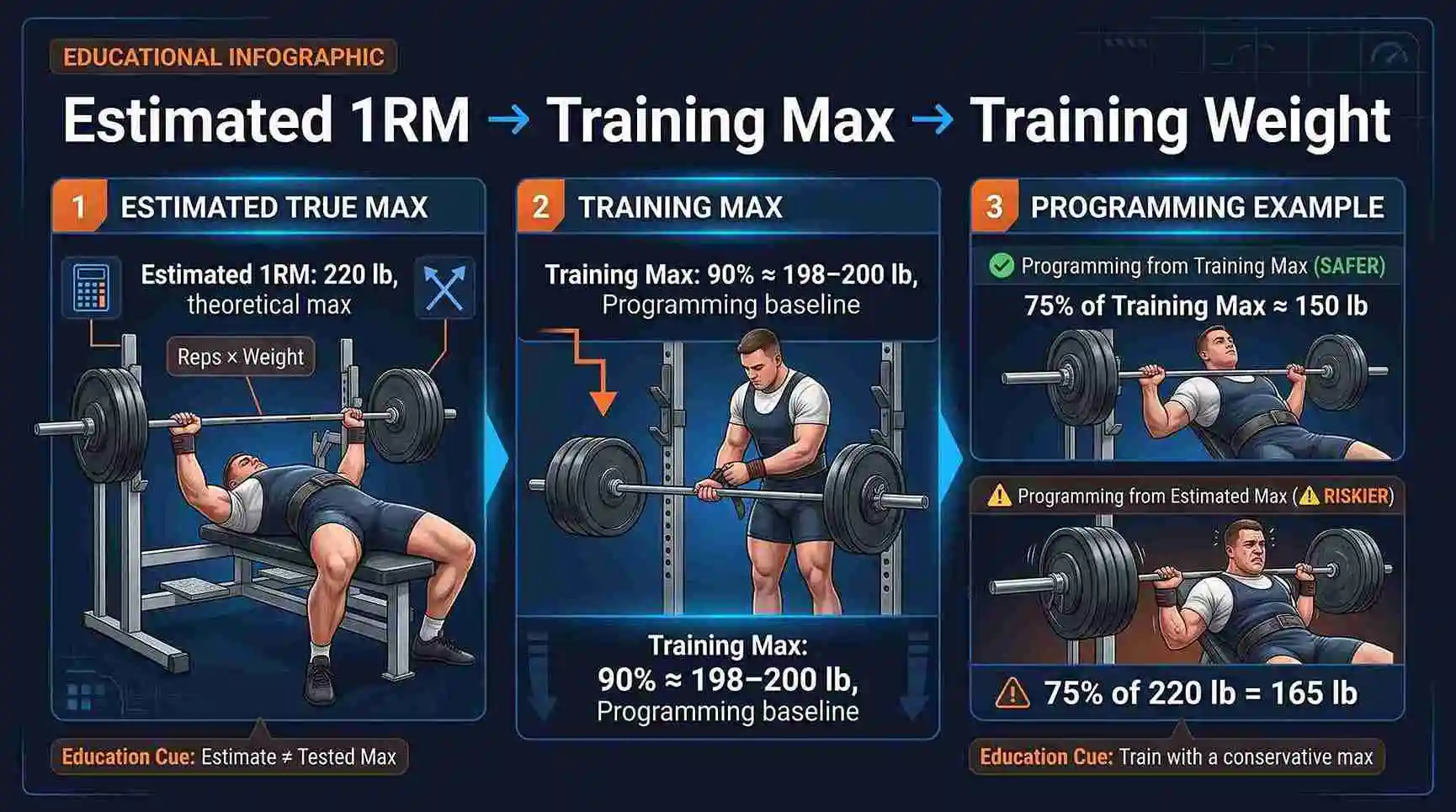
Your true max is what the calculator gives you — your theoretical single-rep ceiling based on the set you entered. Your training max is the number you should actually build your program around, and it’s usually a bit lower — commonly around 90% of your estimated true max.
Why the gap? A formula-based estimate assumes fresh muscles, dialed-in technique, and a bar speed you can only really guarantee on a good day. Training off your true max every session is a fast way to plateau or get hurt. Training off a slightly conservative training max gives you room to actually hit your numbers, week after week.
So a 220 lb estimated max gives you a training max closer to 198–200 lb. If a program calls for “75% of max,” you’d base that on the training max — around 150 lb here, not 165 lb.
Why Your Number Changes Between Sets
This is the most common source of confusion with any 1RM estimate, and it’s rarely explained anywhere. Bench 225 lb for 10 reps and you’ll get one number. Bench 245 lb for 4 reps a week later and you’ll get a different one. You’re not doing anything wrong — the formula behaves this way by design.
As rep count climbs, more variables creep in: fatigue, small breakdowns in form, how much you grind out the last couple of reps. All of that adds noise. A heavier set with fewer reps removes most of that noise, because there’s less room for technique to drift before the set ends.
Reliability by rep range:
- 1–5 reps — most reliable, minimal fatigue distortion
- 6–10 reps — solid for everyday training, expect a bit more variance
- 10+ reps — least reliable, treat as a rough ballpark rather than a precise number
If two sets give you different estimates, trust the one with fewer reps.
The Formula: How the Estimate Is Calculated
This bench press calculator uses the Epley formula, one of the most widely used methods for estimating 1RM from a submaximal set:
Using the earlier example — 200 lb for 3 reps:
No formula is perfect. Epley tends to track reasonably close to reality in the low-to-moderate rep range — treat the output as a strong training guideline, not a number you’re guaranteed to hit without ever testing it.
Training Percentages: Turning Your Max Into Working Weights
Once you have your number (ideally your training max, not the raw estimate), use it to set weights for different goals:
| % of Max | Typical Use |
|---|---|
| 50–65% | Technique work, warm-up sets |
| 70–80% | Volume / hypertrophy work |
| 85–92% | Strength work |
| 93–100%+ | Peaking, near-max attempts |
With a 198 lb training max: volume work sits around 140–158 lb, strength work around 168–182 lb, and near-max work around 185–198 lb. (You can also estimate your squat numbers using our Squat Max Calculator).
Is My Bench Press Good?
There’s no single right answer — it depends on bodyweight, training age, and how long you’ve trained consistently. A number that’s impressive for someone new to structured training might be an off day for someone with years under the bar.
What matters more than comparing yourself to a chart is tracking your own number over time. Recalculate every few weeks using a fresh set and watch the trend, rather than fixating on one result.
Mistakes That Skew Your Estimate
- Bouncing the bar off your chest — adds momentum that has nothing to do with strength, inflating the estimate.
- Cutting range of motion short — a partial press isn’t the lift the formula assumes; it overstates your real number.
- Testing at very high reps — past 10–12 reps, fatigue adds more noise than the formula can account for.
- Grinding every rep to true failure — leave a rep or two in reserve for a more honest reading.
Frequently Asked Questions
How accurate is a bench press calculator?
It’s a solid estimate, not an exact measurement. Results land reasonably close to reality when the input set is in the 1–8 rep range with clean technique. Accuracy drops as rep count climbs.
What’s the difference between my true max and my training max?
Your true max is the raw estimate. Your training max is a reduced number — usually around 90% of the estimate — that you actually build your training percentages around, so your programming stays sustainable.
Why does my estimate change depending on how many reps I do?
Higher-rep sets introduce more fatigue and technique variation, which affects the formula’s output. Lower-rep sets (1–5) give the most consistent estimates.
Can I use this for incline or dumbbell bench press?
The same formula applies, but those variations typically move less total weight than a flat barbell bench — don’t compare the numbers directly across movements.
How often should I retest my max?
Every 4–8 weeks is reasonable for most training blocks — enough time for real progress to show without constantly chasing a number that hasn’t moved yet.
Your bench press calculator result is a starting point, not a verdict. Use it to set training weights and track trends over time — then let your actual performance in the gym, not just the number on the screen, tell you when it’s time to test again.