Warm Up Calculator
Most lifters either skip warming up or overdo it — both cost you reps on the set that actually matters. Enter your working weight below and the Warm Up Calculator builds a set-by-set ramp — weight, reps, and rest — so you walk into your working set primed instead of cold or already tired. Looking for more strength-training tools? Browse our full collection of lifting calculators to plan every part of your session, not just the warm-up.
Gym Warm-Up & Plate Loading Assistant
Generate an optimized, fatigue-free warm-up progression plan with exact plates per side, plate change instructions, and recommended rest periods.
⚙️ Advanced Warm-Up Customizations ▼
Step-by-Step Gym Warm-Up & Plate Plan
Follow this sequence in the gym. Every set shows exact plates per side, plate change guidance, and rest periods.
How to Use the Warm Up Calculator
Most warm-up “rules of thumb” don’t tell you what number to actually load, so lifters either guess or skip straight to the working weight. That’s where a warm up sets calculator is useful — it turns the ramp into specific weights and reps instead of leaving you to guess.
Enter the weight you’re working up to today — not your all-time max, unless you’re specifically prepping for a max attempt. Planning five sets of five at 225 lb? Enter 225. The calculator generates a short sequence of lighter sets climbing toward that number, so your joints, nervous system, and technique are already switched on by the time the bar is loaded.
Two things shape the output:
- Bar weight — a warm-up set can never be lighter than the empty barbell itself, so a 35 lb women’s bar and a 45 lb standard bar produce slightly different ramps for the same working weight.
- Ramp type — controls how many sets the ramp has and how heavy the last one gets, because a hypertrophy set of ten doesn’t need the same runway as a near-maximal single.
Chasing a personal record or a competition opener instead of a normal training day? Switch to max-attempt mode — the logic is related but not identical (covered below).
How the Warm-Up Ramp Is Calculated
Most warm-up calculators show numbers without explaining where they came from, so lifters don’t trust — or don’t understand — the output. The Warm Up Calculator keeps the calculation simple: each set is based on your working weight and a percentage of it.
In plain terms: each warm-up set is your working weight × a percentage , rounded to a loadable increment, and floored at your bar weight. That’s the entire formula. A 70% step on 225 lb comes out to 157.5 lb, rounded to whatever plates you can load — usually 155 or 160 lb. If a percentage would land below your bar weight, that step just becomes an empty-bar set instead of an unusable fraction.
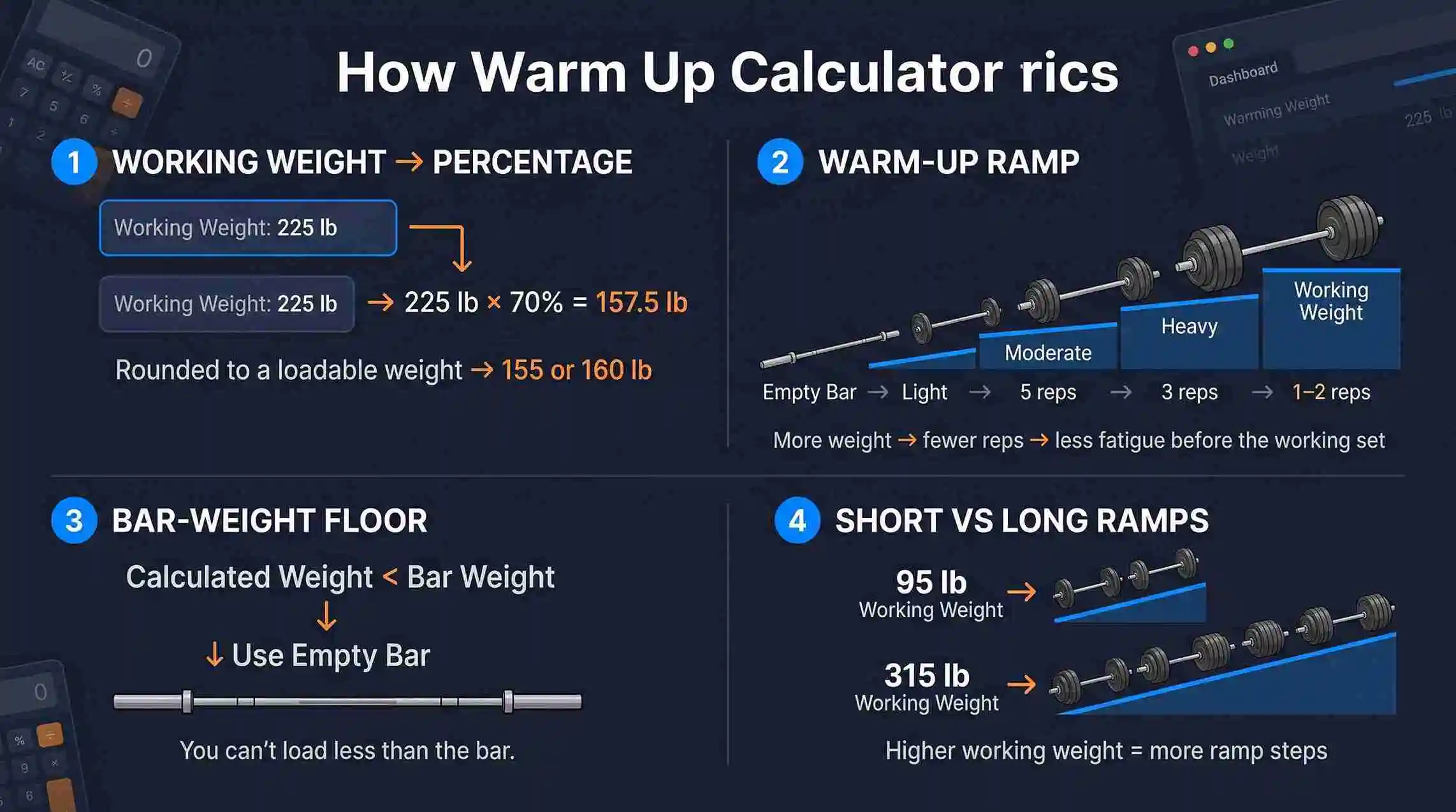
Why reps drop as the weight climbs: early sets are light enough to do five or eight reps for free — those reps raise muscle temperature and groove the movement before it counts. Once you’re close to your working weight, reps stop being free. A five-rep set at 85% is genuinely taxing, and spending it before your working set steals energy you need later. That’s why the top of the ramp drops to a single or double — just enough to feel the weight, not enough to fatigue you.
Why the ramp is “floored” at the bar: you can’t load less than the empty barbell, so any percentage below that becomes a plain bar set. Practical result — a working weight just above your bar produces a short ramp, since most percentages collapse into that same starting point; a working weight far above the bar needs more rungs to close the gap. Warming up to 315 lb naturally takes more sets than warming up to 95 lb — the calculator isn’t being inconsistent, it’s reflecting how much ground there is to cover.
Choosing the Right Ramp for Your Training Goal
A warm-up built for a heavy single is overkill for hypertrophy work, and a warm-up built for hypertrophy under-prepares a max-effort lift. For heavy days, a heavy warm up calculator can help you use smaller jumps and longer rest as you approach the top set.
| Ramp Type | Best For | Structure |
|---|---|---|
| Strength | Heavy top sets, 5 reps or fewer, 80%+ of working max | Empty-bar primer + ascending sets to ~90%, longer rest near the top |
| Hypertrophy | Higher-rep sets (8–15 reps) at moderate load | Short 2-step ramp — roughly 55% then 75% of working weight |
| Quick | Accessory lifts, time-pressed sessions, or exercises after you’re already warm | 2–3 loaded sets, no near-top rungs |
Pick the ramp that matches what your working set is actually asking of your body — not the one that feels the most thorough.
Warm-Up Guidance by Lift
Squat, bench, deadlift, and overhead press each demand different mobility and neural preparation, but most generic advice recycles the same warm-up for all four.
Squat. Needs the longest mobility and neural primer of the four lifts — hip/ankle mobility, depth, and bracing all need dialing in before the weight gets heavy. Typical sequence: empty bar × 8, light × 5, ~50% × 5, ~70% × 3, ~85% × 1–2, then your working set. Building toward a max? Add a single around 92% before the attempt — and if you want to know exactly what that number should be, run your numbers through our squat max calculator first so this ramp is climbing toward a realistic target. Check your depth on a mid-load set — cheaper to fix there than mid-working-set.
Bench press. Shorter ramp than squat, but technique (arch, leg drive, bar path) is fragile under fatigue, so warm-up sets double as technique rehearsal. Sequence: empty bar × 10, ~40% × 5, ~60% × 3, ~75% × 2, ~85% × 1, working set. Working a paused bench? Include one paused rep around 75% so the pause isn’t a surprise later.
Deadlift. Mostly about set-up rehearsal, not muscle priming — every rep is close to a maximal neural event, so keeping volume low protects your working sets. You also can’t pull an empty bar off the floor, so start around 135 lb (60 kg) with full plates, or raise the bar on blocks if lighter. Then: ~30% × 5, ~50% × 3, ~70% × 2, ~85% × 1, working set. Avoid sets of five above ~50% — the fatigue cost outweighs the benefit.
Overhead press. Needs more shoulder and thoracic mobility than the other three lifts. Sequence: bar × 10 with mobility work between sets, ~50% × 5, ~70% × 3, ~85% × 1, working set. Make the first set slower and more deliberate — pressing overhead against gravity punishes rushed reps more than any other lift.
Warming Up for a 1RM, PR, or Meet Attempt
Using the Warm Up Calculator’s everyday ramp for a max attempt either under-primes you or burns energy you need for the lift that counts.
Four adjustments for a maximal single:
- More sets, smaller jumps near the top — add singles at 90% and 95% instead of jumping straight from 85% to your attempt.
- Longer rest at the top — 3–5 minutes between your last warm-up single and the attempt, so your nervous system fully recovers.
- A technical primer single — a clean rep at 85–90% rehearses the attempt itself, more useful here than another submaximal triple.
- Less volume early on, not more — every unnecessary rep is energy you’re not saving for the lift that matters.
Not testing a max today? Use the standard working-weight ramp instead — shorter, no primer single, no unnecessary fatigue. On competition day, time your last warm-up around the call-out clock so your attempt lands while you’re still primed.
How Popular Programs Approach Warm-Ups
If your program has its own warm-up convention, this calculator’s percentage ramp can feel like it’s contradicting your plan.
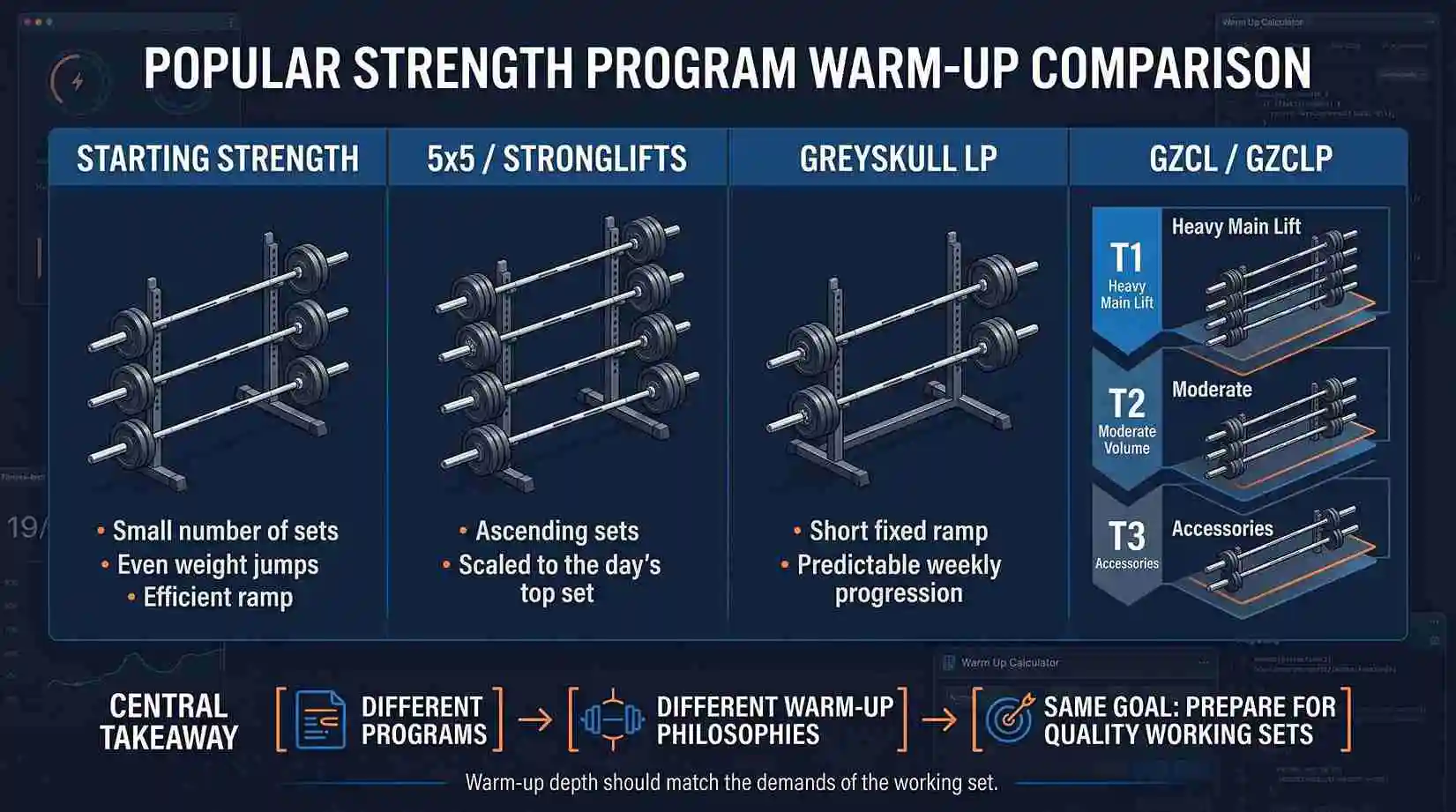
- Starting Strength — a small, fixed number of sets in even jumps, prioritizing efficiency over a long ramp.
- 5×5 / StrongLifts — a handful of ascending sets at round numbers, scaled to how heavy the day’s top set is.
- Greyskull LP — a short, fixed ramp, in line with the program’s small, predictable weekly jumps.
- GZCL / GZCLP — organizes lifts into tiers (T1 heavy main lifts, T2 moderate volume, T3 accessories), so warm-up depth changes by tier — a heavy T1 set justifies a full ramp; T3 accessories usually don’t.
None of these are wrong — they’re different philosophies on how much ramping a given set deserves. If your program doesn’t specify one, the percentage-based ramp above is a solid default.
Reading Your Warm-Up Sets, Not Just Lifting Them
Lifters often treat warm-ups from the Warm Up Calculator as a box to check, missing the readiness signal sitting right in front of them.
Pay attention to how your third or fourth set feels:
- Feels normal or faster than usual → proceed as planned, maybe nudge the working set up slightly.
- Feels heavier or grindier than usual → you’re under-recovered — hold your working weight or scale back volume.
- Feels technically unstable (bar drifting, balance off) → add an extra warm-up set as technique rehearsal before loading up.
No equipment needed — just treat the ramp as information, not a formality.
Warming Up Without a Barbell
Most warm-up advice assumes a barbell, leaving dumbbell and machine lifters without a clear system.
Same logic applies — you’re still building an ascending sequence toward your working load — you just lose the empty-bar starting point. Start with the lightest loadable option (smallest dumbbell pair, lowest usable pin) and do two or three ascending sets, rounding to what you can actually load. Fewer total sets are usually needed here, since there’s no near-maximal single to build toward.
Common Warm-Up Mistakes
- Too many reps near the top — the last sets should be singles or doubles, not another set of five.
- Skipping the empty bar — the cheapest rehearsal you get, at essentially zero fatigue cost.
- Same ramp every session, regardless of load — a heavy day needs more rungs than a light one.
- Resting too long on early sets — save the longer rest for the sets closest to your working weight.
- Warming up to failure — every warm-up set should stay clearly short of failure; a warm-up that gasses you has already failed its job.
FAQ
How many warm-up sets should I do?
Usually three to six, depending on how heavy the working set is and how technical the lift is. A moderate set of five needs three or four rungs; a near-max single usually wants five or six with smaller jumps near the top.
Should warm-up sets ever be taken to failure?
No. A warm-up set that’s genuinely difficult has already stopped doing its job — it should feel clearly manageable, stopped well short of what you could grind out.
Do I need a full warm-up for every exercise in a session?
Only for the first heavy movement in a pattern. Squat first, then leg press? The leg press only needs a feeler set or two, since your legs are already warm.
Does warming up actually prevent injury?
The evidence is genuinely mixed — studies on injury risk specifically don’t point one clear direction. Performance is better supported: a structured warm-up tends to improve bar speed and movement quality on the sets that follow.
Should my warm-up be based on a percentage of my 1RM, or today’s working weight?
For everyday training, the Warm Up Calculator works best from your working weight — you pick the set and the ramp builds backward. For a max attempt, basing it on your 1rm is more useful, since the jumps near the top need to land at known intensities (~85%, ~92%, then the attempt).