
WILKS CALCULATOR POWERLIFTING WILKS SCORE & COEFFICIENT (KG/LB)
Use this free Wilks calculator to convert your squat, bench press, and deadlift total into an accurate, bodyweight-adjusted Wilks score — the same Wilks Coefficient formula devised by Robert Wilks of Powerlifting Australia and used by the IPF to rank relative strength across weight classes. Just enter your gender, bodyweight, and best lifts in kg or lb to get an instant powerlifting score you can compare against any lifter, regardless of size or weight class. Whether you’re chasing a Best Overall Lifter title, checking the Wilks score chart to see where you rank, or comparing Wilks vs. DOTS and IPF GL Points, this calculator gives you a fast, reliable answer.
Wilks Powerlifting Performance Engine
Calculate official bodyweight-adjusted Wilks score, analyze lift contribution balance, and simulate scenario total targets.
Your Wilks score adjusts your powerlifting total for bodyweight, making totals easier to compare across different body sizes.
Lift Contribution Balance
Percentage contribution of Squat, Bench Press, and Deadlift toward total powerlifting load.
🎯 Target Wilks & Total Planner ▼
⚡ Interactive "What-If" Scenario Simulator ▼
Test hypothetical lift or bodyweight changes live without modifying your current result.
📜 Saved Wilks History & Progress ▼
| Date | BW (Sex) | S/B/D | Total | Wilks | Action |
|---|
Calculate Your Wilks Score in Seconds
You know that feeling when you hit a new PR and someone bigger than you shrugs it off? That’s the exact frustration the Wilks calculator was built to end. Punch in your gender, bodyweight, and your best squat, bench, and deadlift, and you’ll get a real, bodyweight-adjusted score — no guessing, no arguing at the gym.
Why Lifters Actually Need This Tool
Honestly, most of us have wondered the same thing at 2am after a heavy session: am I actually strong, or just strong for my size? A lot of local meets score by Wilks instead of total kilos moved, so if you don’t know your number, the Wilks Calculator gives you a quick way to check where you stand. And doing this by hand? Forget it — six-decimal coefficients and a fifth-order polynomial aren’t something anyone wants to wrestle with after leg day.
What Is the Wilks Score, Really?
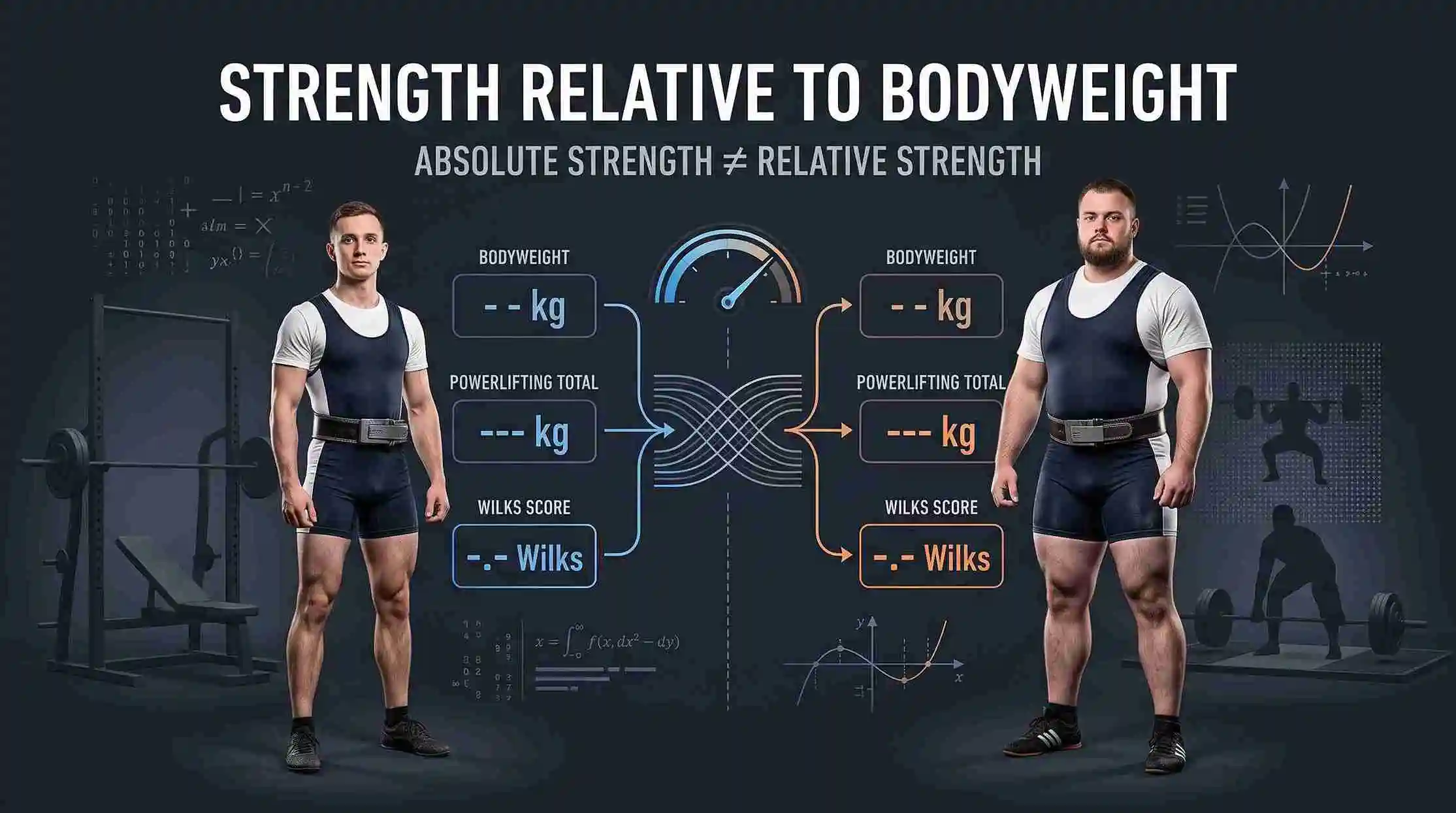
The Wilks score — some people still call it the Wilks Coefficient — was Robert Wilks’ answer to a genuinely annoying problem in powerlifting: how do you compare a 60kg lifter to a 120kg lifter fairly? His formula takes your total and quietly adjusts it for your boadyweight, so the comparison actually makes sense instead of just favoring whoever’s biggest.
Without something like this, the heaviest guy in the room always “wins” on paper, even if a lighter lifter is dragging way more weight relative to their frame. That’s not fair, and frankly it never told the full story. This is exactly why national federations and the IPF have leaned on Wilks for years to crown the Best Overall Lifter when everyone’s competing across different weight classes.
The Formula (For the Curious Ones)
Wilks Score = Total (kg) × Coefficient, and the Coefficient itself comes from 500 divided by a nasty little polynomial: a + b·x + c·x² + d·x³ + e·x⁴ + f·x⁵. Here x is just your bodyweight in kg. The shape of the equation stays the same for everyone — it’s only the constants that shift between men and women.
| Constant | Male | Female |
|---|---|---|
| a | −216.0475144 | 594.31747775582 |
| b | 16.2606339 | −27.23842536447 |
| c | −0.002388645 | 0.82112226871 |
| d | −0.00113732 | −0.00930733913 |
| e | 7.01863×10⁻⁶ | 4.731582×10⁻⁵ |
| f | −1.291×10⁻⁸ | −9.054×10⁻⁸ |
How to Use It Without Overthinking It
Pick your gender first in the Wilks Calculator, since that decides which set of constants gets used behind the scenes. Choose kg or lb, drop in your 1RM, then your squat, bench, and deadlift or your total if that’s easier. Hit calculate — that’s genuinely it.
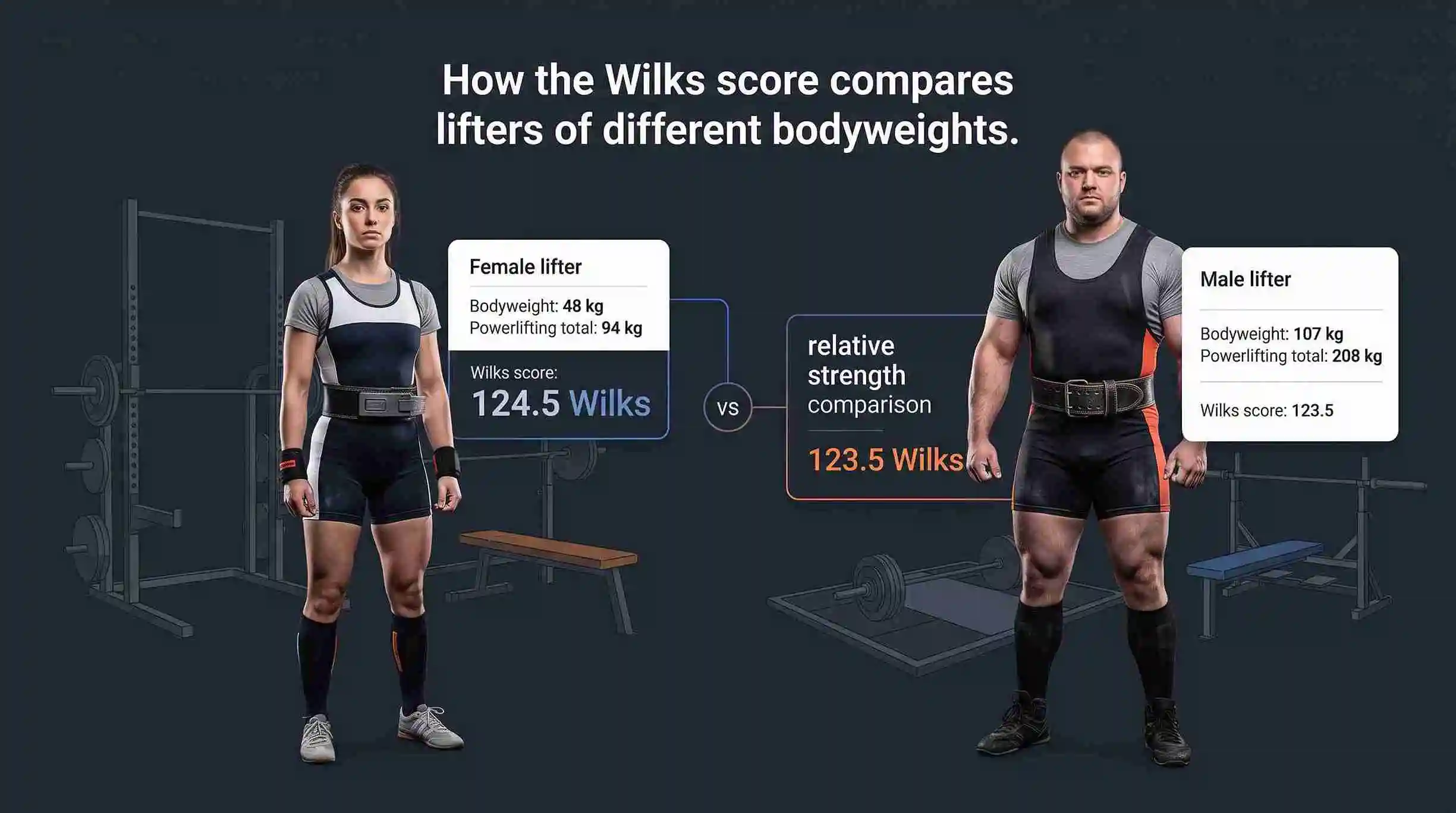
Here’s a real example that always surprises people the first time they see it. A 48kg woman with a 94kg total ends up around 124.5 Wilks, while a 107kg man totaling 208kg lands closer to 123.5. She lifted less weight in absolute numbers, yet her score edges his out — and that’s the whole point of this formula existing in the first place.
So… What’s Actually a Good Score?
| Wilks Score | Classification |
|---|---|
| Below 200 | Beginner |
| 200 – 300 | Intermediate |
| 300 – 350 | Advanced |
| 350 – 400 | Elite |
| 400 – 450 | World Class |
| 450 – 500 | Exceptional |
| 500+ | All-Time Great |
If you’re a guy one year into training, 200–250 is pretty normal, and elite lifters usually sit north of 400. Women tend to land around 150–200 after year one, climbing to 350–400+ at the elite level. Anything past 700 is the stuff of legend, mostly seen in equipped lifting, while a raw score over 550 already puts you in rare company.
Wilks Numbers by Weight Class
| Weight Class (kg) | Total Needed for 400 Wilks (kg) |
|---|---|
| 59 | 475 |
| 66 | 520 |
| 74 | 565 |
| 83 | 610 |
| 93 | 655 |
| 105 | 700 |
| 120 | 745 |
| 120+ | 790+ |
These numbers are rough guides, nothing more. Your real score depends on the Wilks Calculator above, so treat this table as a ballpark, not gospel.
Why This Number Actually Matters
At most bigger meets, Wilks is what decides who walks away with Best Overall Lifter, cutting across every weight class in the room. It’s also just genuinely useful for tracking your own progress, especially when your bodyweight won’t sit still through a training block. At the end of the day, it gives you one honest number to measure yourself against anyone — any gym, any weight class, any decade.
How to Actually Move the Needle
There’s no secret here — progressive overload on your squat, bench, and deadlift is still what moves the number most. Cleaning up sticking points, tightening your bar path, fixing your bracing — these small things quietly add kilos without you feeling “stronger” day to day. Training with real feedback, like tracking bar speed, also helps you peak at the right moment instead of guessing.
Body composition plays a role too, since the formula rewards a strong total relative to your weight. That doesn’t mean cutting weight recklessly the week before a meet — it means planning it properly across a full cycle. And don’t underestimate simply competing more; better attempt selection alone can add several percent to your total that training never would.
Wilks vs. DOTS vs. IPF GL — Does It Even Matter?
| Feature | Wilks | DOTS |
|---|---|---|
| Developed | 1990s | 2019 |
| Bodyweight bias | Slightly favors heavier lifters | More balanced |
| Best for | Historical comparisons | Modern comparisons |
DOTS came along later specifically to fix Wilks’ soft spot for heavier lifters. These days the IPF officially uses GL Points (Goodlift), tweaked periodically as new competition data rolls in. Before your next meet, it’s worth double-checking which system your federation is actually using — they’re not always the same.
Frequently Asked Questions
What is the Wilks score?
It’s a coefficient that scales your powerlifting total against your bodyweight, so lifters of different sizes can be compared fairly. A higher number simply means more relative strength, not just heavier lifts.
How is it calculated?
Your total gets converted to kg if needed, then run through a formula that’s specific to your gender and bodyweight. Out comes one clean score you can actually compare against anyone else’s.
What’s a good score for a beginner?
Somewhere around 200–250 is completely normal for someone a year into training. Stick with it for 2–3 years and 300+ is realistic.
Is 300 Wilks actually good?
Yes — that’s advanced territory, ahead of most recreational lifters. Usually it takes a solid 2–4 years of focused, consistent training to get there.
What’s the highest Wilks score ever?
Scores have crossed 700 in equipped divisions, which is genuinely wild. In raw lifting, anything above 550 is considered historic.
Wilks or DOTS — which is better?
Neither is “wrong,” honestly. DOTS handles extreme weight classes more evenly, but Wilks still has more history and recognition behind it.
Does the formula change between men and women?
The structure stays identical, but the constants swap out by gender. That’s what keeps scores fair to compare within each group.
Can I use Wilks on just one lift?
You technically can, but it wasn’t built for that and the result won’t mean much. It’s really meant for your combined squat, bench, and deadlift total.
Why does bodyweight change the score so much?
Lighter lifters get a bigger coefficient, so every kilo they lift counts for more in the formula. That’s the entire mechanism that makes this comparison work at all.
Why is my score different from another site’s calculator?
Usually it’s outdated constants, rounding differences, or a tool quietly mixing in DOTS or IPF GL numbers instead of the classic Wilks Calculator method. This one sticks to the classic Wilks coefficients, rounded to two decimals.
How do I actually raise my score?
Push your total up across all three lifts while keeping bodyweight in check. Good programming, real recovery, and smart peaking do more than people expect.
How often should I check it again?
Every competition or testing block is a good rule of thumb. Bodyweight shifts around too much to trust a single number for long.