

Dumbbell to Barbell Bench: How to Convert Your Max
On this page
Why Is My Dumbbell Bench So Much Lower Than My Barbell Bench?
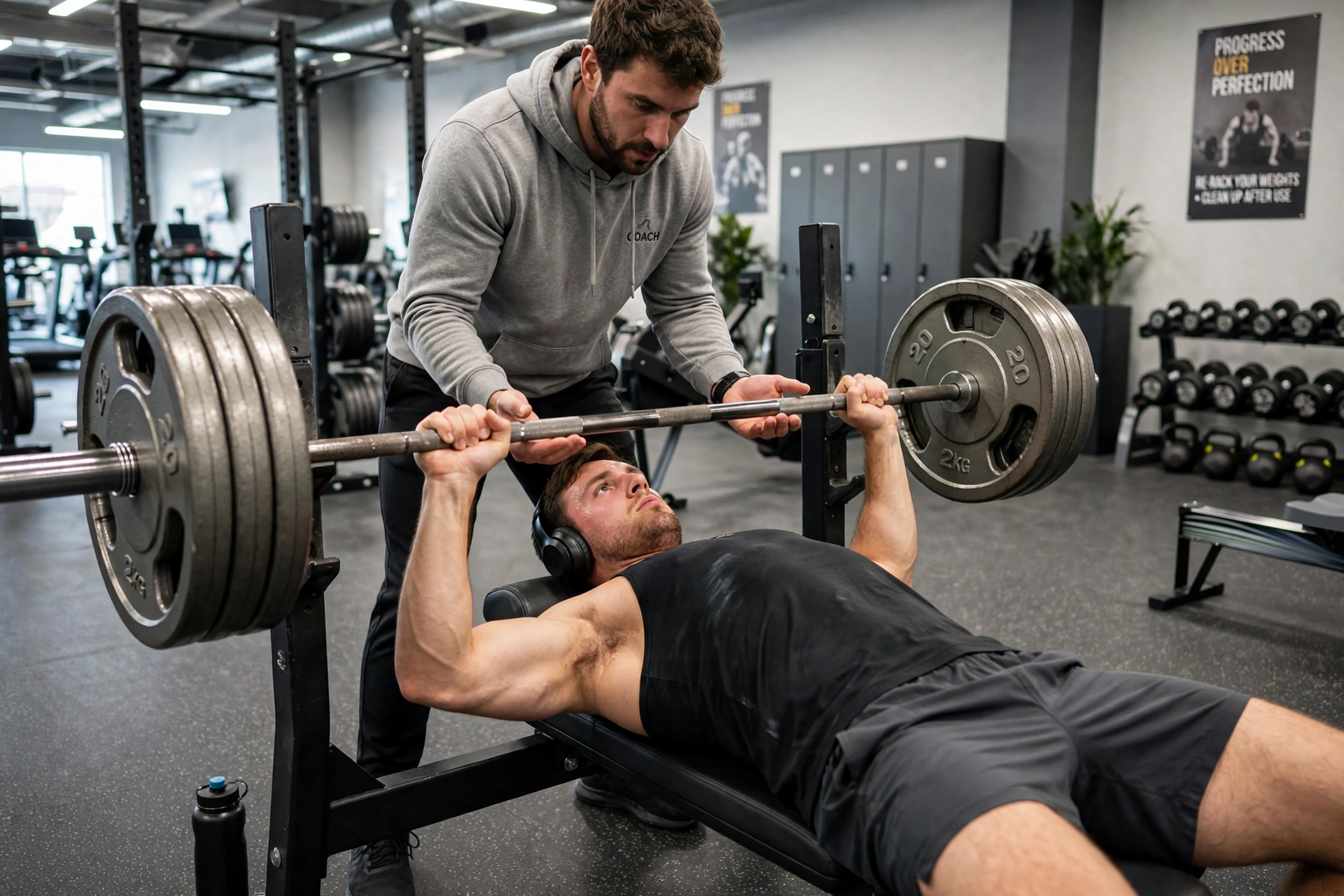
Think about what’s actually happening at the bottom of a dumbbell rep. Two independent weights, each trying to drift its own direction, and the only thing keeping them on track is the small stabilizer musculature around your shoulder joint. On a barbell, the bar itself does half that job for you — both hands are locked to the same rigid object, moving along one path.
That’s the whole story. Nobody who barbells 225 is repping the 110s — the gap is widest when pressing muscles are strong but stabilizers lag, which is most people new to dumbbells.
So if your dumbbell numbers look embarrassing next to someone’s barbell numbers: stop comparing. They’re different lifts, and your dumbbell total running lower isn’t a weakness. It’s physics.
How Do I Convert My Dumbbell Bench to a Barbell Max?
Step 1 — combine the dumbbells. You pressed the 80s. That’s 80 + 80 = 160 lb of total weight moved. This is the number the formula needs.
Step 2 — estimate your dumbbell one-rep max. Run 160 lb × 8 reps through Epley (1RM = weight × (1 + reps ÷ 30)):
160 × (1 + 8 ÷ 30) = 160 × 1.2667 = 202.7 lb
That’s your dumbbell e1RM — roughly what you’d press for a single with the dumbbells, if you ever tested it (most people never do, and shouldn’t need to).
Step 3 — add the barbell premium. A barbell lets you move more than two dumbbells, because the stabilization demand drops away. In practice, experienced lifters land about 10–20% above their dumbbell e1RM:
202.7 × 1.10 = 223 → 202.7 × 1.20 = 243
Round to plate-friendly numbers and you’ve got 225–245 lb. Here’s the same math for a few common dumbbell sets:
| Your dumbbell set | Combined weight | Dumbbell e1RM (Epley) | Barbell estimate |
|---|---|---|---|
| 60s × 8 | 120 lb | 152.0 lb | 165–185 lb |
| 80s × 8 | 160 lb | 202.7 lb | 225–245 lb |
| 100s × 8 | 200 lb | 253.3 lb | 275–305 lb |
One honest note on that 10–20%: it isn’t a formula — it’s the observed range. Beginners sometimes jump more (shaky stabilization held them back); experienced dumbbell pressers land nearer 10%. Use the range, not a single number.
Do I Enter One Dumbbell or Both Into a 1RM Calculator?
This is the single most common mistake in dumbbell-to-barbell conversion, and I see it constantly. Someone presses the 90s for 6, types “90 × 6” into a calculator, gets ~108 lb, and concludes their barbell bench is barely over a plate. Then they unrack 135 on a barbell and it flies up, and they think the calculator is broken. It isn’t — the input was.
The formula doesn’t care what implement you used — only total weight moved and reps. Two dumbbells: add them. Single-arm work: enter the one. Log it the same way every time.
How Accurate Is This Conversion?
Two layers: the formula (Epley predicting your dumbbell single — validated research, tighter at low reps, looser past 10) and the 10–20% premium (coaching observation, not a lab study — nobody’s run a randomized dumbbell-to-barbell trial). The range is real, but it’s not precise.
That’s exactly why this page gives you ranges instead of a single magic number. A converter that spits out “your barbell max is 237.4 lb” is lying with decimals. “225 to 245” tells the truth: here’s the neighborhood, now go confirm it under a real bar.
And please — don’t claim the converted number as your max anywhere that matters. An estimated conversion is a programming input. A PR is a bar you actually lifted. The gym respects the second one.
How Do I Use the Converted Number in a Barbell Program?
The classic scenario: you’ve been running a dumbbell-focused program — home gym, hotel gyms, whatever — and now you’re switching to a percentage-based barbell program. 5/3/1 wants a training max. Starting Strength-style linear progression wants a starting weight. You need a number, not the perfect number.
Conservative is correct: your barbell technique is unpracticed (new setup leaks pounds), and overshooting your training max overshoots every percentage in the program with it. Undershoot slightly and the program just works.
After two or three weeks of actual barbell pressing, forget the conversion entirely. You’ll have real barbell rep sets to feed the calculator, and those beat any estimate-from-an-estimate. The conversion is a bridge, not a home.
Can I Attempt the Converted Max on My First Barbell Day?
Warm up normally, then take singles with real jumps — 135, 185, 205, 225 — resting 3–5 minutes between the heavy ones. Somewhere in that ladder the bar tells the truth. Most lifters land inside the range. Let it happen; don’t force it.
The specific risk with dumbbell-to-barbell jumpers isn’t the chest or triceps — those are ready. It’s the unfamiliar stabilization pattern under a load your prime movers can handle but your shoulders have never managed on a fixed bar. That’s how you get a rep that drifts toward your face or a shoulder that complains for a week. A patient ramp-up costs you twenty minutes. An injury costs you months.
Bring a spotter. That was true for dumbbells and it’s doubly true the first time you put real weight on a barbell.
Frequently Asked Questions
Why is my dumbbell bench so much lower than my training partner’s barbell bench?
Does this conversion work for overhead press?
What if I already know my dumbbell 1RM?
Should I use Epley or Brzycki for the dumbbell estimate?
Why do two calculators give me different converted maxes?
Sources
- LeSuer, D.A. et al. (1997). “The accuracy of prediction equations for estimating 1-RM performance in the bench press, squat, and deadlift.” Journal of Strength and Conditioning Research, 11(4).
Learn more