
Lander Formula: 1RM Equation Explained
The Lander formula is the quiet middle child of 1RM equations — here’s the math, worked examples, and where it fits.

The Lander formula is the quiet middle child of 1RM equations — here’s the math, worked examples, and where it fits.

The O’Conner formula is the simplest 1RM equation — and deliberately conservative. Math, examples, and best uses.
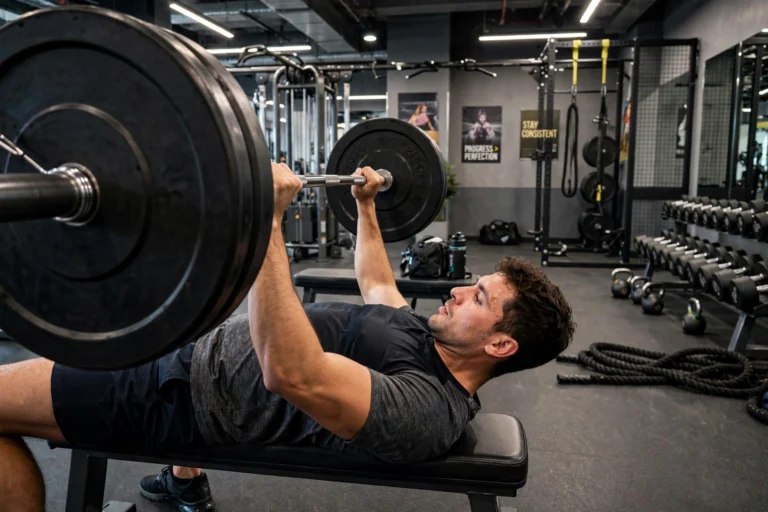
The Mayhew formula held up best for bench press in LeSuer 1997 — here’s how it works and when to use it.

The Wathan formula models 1RM with an exponential equation — math, examples, and how it compares to Epley and Brzycki.

The Lombardi formula estimates your 1RM on an exponential curve — here’s the math, worked examples, and where it shines.

Look up any weight × reps and read your estimated 1RM straight off the chart. Full Epley-based conversion table.

The complete 1RM percentage chart from 50–100%, with reps, training zones, Prilepin’s volume table, and the training-max trick. Turn your max into actual working weights for any program.

The Brzycki formula — 1RM = weight × 36 ÷ (37 − reps) — is the research favorite for bench press at low reps. Honest at 1 rep, conservative below 10, but never use it past ~12 reps: the math destabilizes.

The Epley formula — 1RM = weight × (1 + reps ÷ 30) — is the most-used 1RM equation in apps and textbooks. Worked examples in lb and kg, when it’s most accurate, and its limits past 10 reps.

Seven formulas, one lift, seven different answers. Head-to-head comparison of Epley, Brzycki, Lombardi, Mayhew, O’Conner, Wathan, and Lander — with the exact numbers, the 10-rep crossover, and why the average beats any single formula.
End of content
End of content