Squat Max Calculator
Enter the weight you squatted and how many reps you completed. The squat max calculator estimates your one-rep max (1RM) — the heaviest weight you could squat once, with good form, right now.
Squat 1RM Decision Engine
Enter your squat lift details to calculate 1RM, reliability rating, squat training loads, and plate breakdown.
💡 RPE / RIR Squat Effort Scale Guide ▼
Input is in an optimal low-rep strength zone (1–5 reps) where formula agreement is very high.
* This is an estimate based on weight, reps, scientific formulas, and RIR effort. Actual squat 1RM varies with readiness and fatigue.
What do you want to do next?
| Percentage | Calculated Load | Est. Rep Range | Training Focus |
|---|
Safety Note: Always perform squat max attempts with a safety rack, properly set safety pins, and qualified spotters.
| Formula Name | Estimated 1RM | Variance vs Recommended |
|---|
Different scientific equations apply unique mathematical models to squat rep endurance curves.
Bodyweight Relative Squat Strength Ratio
🎯 Reverse Squat 1RM Target Finder ("I want a X Squat 1RM") ▼
Log Current Squat Lift to Local History
| Date | Squat Variation | Weight × Reps | Est. 1RM | Change | Action |
|---|
🧪 Formula Accuracy Calibration (Tested vs Estimated Squat Max) ▼
How to Use the Squat Max Calculator
Type in the weight you squatted and the number of clean reps you got — that’s it. The squat max calculator runs the math instantly.
The part that actually matters is which set you use. Pick a set of 2 to 10 reps, taken close to failure, where your depth and form held up on the last rep the same way they did on the first. That’s the range where rep-based formulas track real strength most closely. A set of 20 fast, bouncy reps will hand the calculator a set that says more about your conditioning than your squat strength, and the estimate will drift because of it.
If you’ve got a choice between two recent sets, use the heavier one done for fewer reps rather than the lighter one done for more. Lower-rep sets are less sensitive to pacing and grip and more sensitive to actual load-bearing strength, which is the thing you’re trying to measure.
What Your Squat Max Actually Means
Your squat max — your 1RM — is the most weight you can squat for one complete repetition, to a depth and with a bar path you’d be comfortable showing on video. The squat max calculator estimates this number from a submaximal set. That last part matters more than people give it credit for. A quarter-squat with 400 pounds and a proper-depth squat with 400 pounds are not the same lift, even though a rep-counting calculator can’t tell the difference. The number this tool gives you is only as honest as the rep you used to generate it.
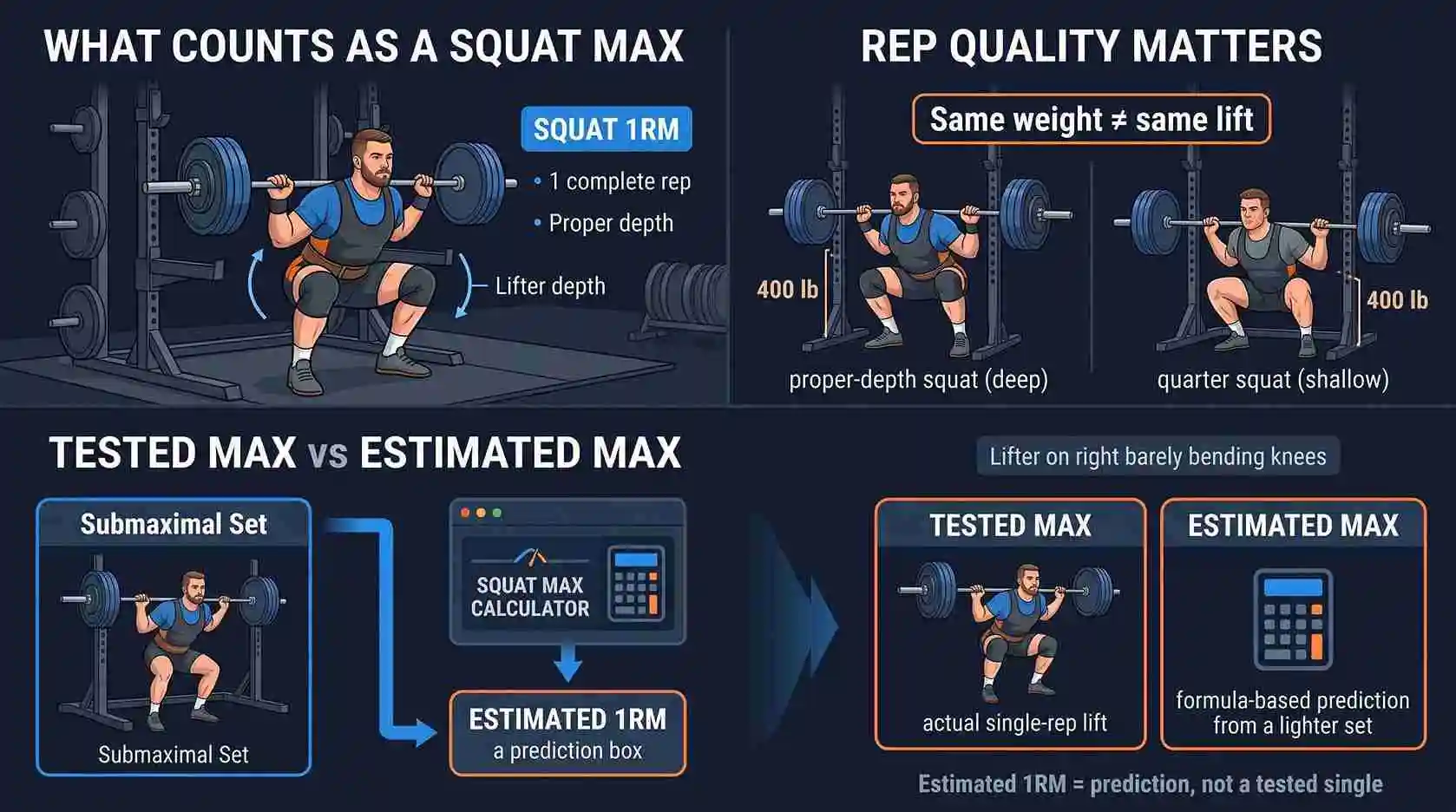
There’s also a difference between a tested max and an estimated max. A tested max is a true single — you actually walked up to the bar and squatted that exact weight once. An estimated max, which is what this calculator produces, is a prediction based on a lighter set. It’s not a guess pulled from nowhere; it’s built on formulas that model how strength and fatigue trade off as reps increase. But it’s still a prediction, and predictions carry some margin of error, which is worth understanding before you treat the number as gospel.
How Accurate Is This Estimate — And Why Squats Are Different
Rep-based 1RM formulas were built by watching how weight and reps trade off across many lifters and many exercises, then fitting an equation to that pattern. That’s the same basic approach used by a squat max calculator to estimate your strength. They work reasonably well when your set looks like a “normal” strength curve — steady technique, consistent tempo, no major fatigue distorting the picture. The tighter your set matches that pattern, the closer the estimate lands to what you’d actually squat for one rep.
Squats are more sensitive to this than a lift like the bench press, for one simple reason: depth is a variable you control rep to rep, and it’s the first thing that slips when a set gets hard. That’s important when using a squat max calculator, because the formula cannot judge whether each rep reached the same depth. On a bench press, the bar stops at your chest whether rep one or rep eight is grindy. On a squat, nothing stops you from cutting the last few reps a few inches high — and a shallower rep is, mechanically, an easier rep. If your set gets shallower as it goes, the calculator is being fed an easier lift than it thinks it is, and the estimate comes out inflated.
Fatigue carryover is the second squat-specific issue. If you tested your rep-max set at the end of a session that already included heavy deadlifts or a lot of lower-body accessory work, your legs and lower back were pre-fatigued before that squat set even started. The set will look “harder” than it should, which usually drags your estimate down below what you could really do fresh.
Common Mistakes That Skew a Squat Estimate
- Depth drifting shallower as the set goes on. Even an inch or two of lost depth on the final reps makes the set easier than it looks, inflating the estimate.
- The “good-morning” breakdown. When a rep gets heavy, some lifters let their hips shoot up while the chest stays down, turning the last part of the rep into more of a hip hinge than a squat. It lets you grind out reps you didn’t really squat.
- Testing after your legs are already fatigued. A set done after heavy deadlifts, lunges, or leg press will underpredict what you could do with fresh legs.
- Mixing high bar and low bar in the same tracking. These are different lifts with different leverage. Comparing a low-bar set from one week to a high-bar set from another will make your “progress” look noisier than it is.
- Rushing rest between reps in the set. If you’re cutting rest short mid-set to “get the reps in,” you’re testing conditioning as much as strength.
None of these mean the squat max calculator is broken — they mean the input matters as much as the math. A clean, honest set of 5 will give you a far more useful number than a messy set of 12.
The Formula Behind the Number
This calculator’s estimate comes from established rep-based prediction formulas, not a black box. Two of the most widely used are:
- Epley formula: 1RM = weight × (1 + reps ÷ 30)
- Brzycki formula: 1RM = weight × 36 ÷ (37 − reps)
Take a squat set of 100 kg for 5 reps as an example. Epley predicts a 1RM of about 116.7 kg. Brzycki predicts about 112.5 kg. Both are reasonable — they just weight the relationship between reps and fatigue slightly differently. Epley tends to run a little higher as rep counts climb; Brzycki tends to stay a bit more conservative. In the 1–5 rep range specifically, Brzycki is often cited as tracking closest to an actual tested max, which is one reason some strength-tracking tools default to it for lower-rep sets.
Neither formula is “correct” in an absolute sense — they’re both approximations built from patterns in how people perform under load. If you want more confidence in your number, run the same set through both and treat the gap between them as your realistic margin of error rather than picking whichever one gives the bigger number.
Turning Your Squat Max Into Training Weights
A 1RM from the squat max calculator by itself doesn’t tell you what to load on the bar next Tuesday. What it gives you is a reference point you can turn into percentages, and those percentages are what actually drive your training.
Squat Percentage Chart
| % of 1RM | Typical Rep Range | Training Purpose |
|---|---|---|
| 90–100% | 1–2 | Peaking, max-strength testing |
| 80–89% | 3–5 | Strength |
| 65–79% | 6–10 | Hypertrophy / muscle growth |
| 50–64% | 10–15 | Technique, speed, volume accumulation |
If your estimated squat max is 150 kg, an 85% strength day means working sets around 127–128 kg for low reps. A hypertrophy day at 70% means sets closer to 105 kg for higher reps. The percentage doesn’t change — only the number you’re taking the percentage of does, once your max moves. (You can calculate your baseline using our One Rep Max Calculator.
Training Max vs. True Max
Plenty of programs, particularly percentage-based ones, don’t have you train off your actual estimated 1RM directly. Instead, they have you set a training max — usually around 90% of your estimated max — and program all your percentages off that lower number instead.
The reason is simple: your estimated max is a snapshot from one good day. Training at percentages of your true max, week after week, leaves you no margin for a day when you’re a little tired, a little under-slept, or just not moving as well. A training max builds that margin in on purpose. If your squat max calculator estimate comes back at 150 kg, a 90% training max would be 135 kg, and every percentage in your program gets calculated from that 135, not the 150.
Is Your Squat Max Good? (Reading It Against Real Benchmarks)
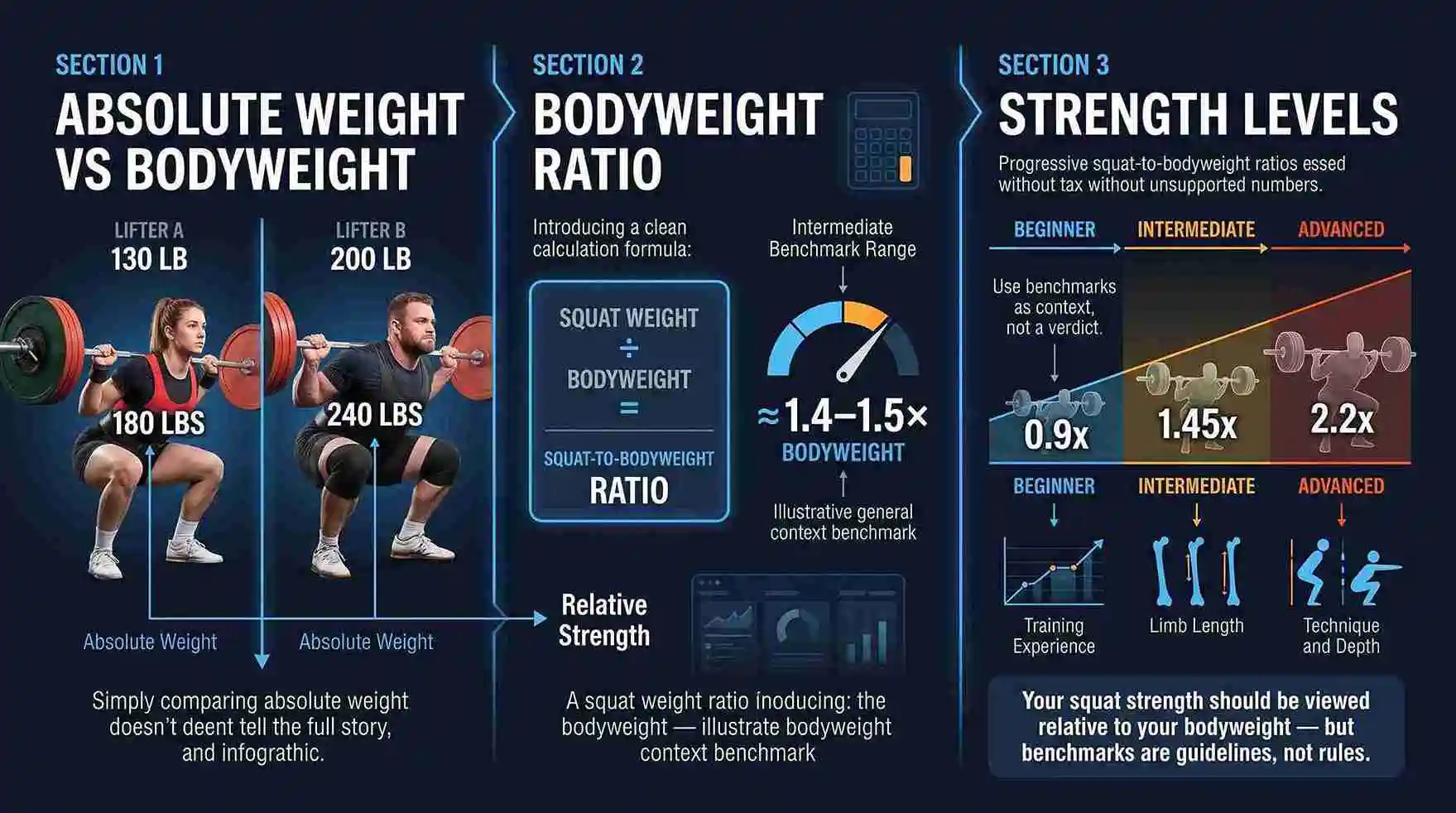
Squat strength is often expressed as a multiple of bodyweight, since that adjusts for the fact that a 200-pound lifter and a 130-pound lifter aren’t playing the same game in absolute pounds. A commonly cited rough guide for an intermediate lifter is a squat around 1.4–1.5 times bodyweight, with beginners well below that and advanced lifters well above it.
Take these ranges as general orientation, not a verdict. Standards tables like this are built from whatever population happened to be sampled — often self-selected lifters who track and report their numbers — and they don’t account for your training age, limb length, or how long you’ve actually been squatting seriously. A 6-foot-4 lifter and a 5-foot-4 lifter can have very different “normal” squat depths and leverages for the exact same relative strength. Use a bodyweight-ratio benchmark to get a general sense of where you sit, not as a target you’re failing to hit if you’re below it.
Front Squat vs. Back Squat, and Bar Position
Your front squat max and your back squat max are related, but they’re not the same number, and they shouldn’t be tracked as if they were.
In a front squat, the bar sits across the front of your shoulders, which keeps your torso more upright and shifts a lot of the demand onto your upper back and core to hold that rack position. That upright torso also shortens the effective lever arm your lower back has to fight against, which is part of why the same lifter’s front squat is almost always noticeably lighter than their back squat — commonly somewhere in the neighborhood of 80–85% of the back squat number, though this varies a fair amount by individual and shouldn’t be treated as a precise conversion.
Within the back squat itself, bar position matters too. A high-bar squat sits the bar higher on the traps, keeps the torso more upright, and tends to bias the quads more. A low-bar squat sits the bar lower across the rear delts, allows more forward lean, and shifts more work to the hips and posterior chain. Neither is more “correct,” but they’re different lifts with different leverages, so switching between them mid-training-block and expecting your max to stay flat isn’t realistic. If you switch bar position, expect your number to move and treat it as a new baseline rather than a regression.
Testing a Real Squat Max Safely
If you want an actual tested max instead of an estimate, the way you get there matters as much as the attempt itself.
Start with a proper warm-up ramp rather than jumping straight to heavy singles. A typical progression works up in stages — lighter sets with more reps early, narrowing down to fewer reps as the weight climbs, until you’re taking singles at increasing loads leading into your attempt. Rushing this, or skipping straight from a moderate weight to a near-max single, is one of the more common ways technique breaks down right when it matters most.
Use safety bars or pins set just below your bottom position, and don’t attempt a true max without a spotter or a rack set up so a failed rep can be safely dumped. This isn’t optional caution for beginners only — missed reps happen to experienced lifters too, and a true 1RM attempt is, by definition, a weight you’re not certain you’ll complete.
Know your stopping point before you start. If your bar speed is dropping sharply between attempts, if your depth or bar path is breaking down, or if anything feels sharp or wrong rather than just heavy, that’s the signal to stop and either walk away with a solid number or come back another day. A true max test isn’t meant to be a grind to failure — it’s meant to find the heaviest weight you can move with the same standard you’d hold yourself to on a submaximal set.
Does a Belt or Knee Sleeves Change Your Number?
A lifting belt doesn’t add strength to your muscles directly. What it does is give your torso something to brace against, which lets you generate more intra-abdominal pressure than bracing without one. More pressure means a more rigid torso under load, and a more rigid torso generally means you can express more of the strength you already have. Most lifters who add a belt to a near-max squat do see a real increase in what they can move, but it’s a stability and bracing effect, not new muscle.
Knee sleeves work differently. They provide compression and mild elastic support around the joint, which can improve stability and comfort at the bottom of the squat, and some lifters report a modest rebound-type effect out of the hole. The effect tends to be smaller and more individual than a belt’s, and it’s more about confidence and joint comfort than a guaranteed number on the bar.
Neither piece of equipment will turn a weak squat into a strong one. What they can do is let you access strength you already have more reliably, particularly as the weight gets close to your true max — which is exactly the range where small losses in bracing or stability cost you the most.
For more specific tracking, if you are also focusing on deadlifts, you can check your progress using the Deadlift Max Calculator.
FAQ
How many reps should I use for the most accurate squat max estimate?
A set of 2 to 10 clean reps, taken close to failure, gives the most reliable estimate. Inside that range, 3–6 reps tends to be the sweet spot — heavy enough to be strength-dominant, light enough that your form and depth don’t fall apart before the last rep.
Why is my squat estimate different from my actual tested max?
Estimates from a squat max calculator are predictions, not measurements. If your set had inconsistent depth, some fatigue carryover from earlier training, or a rep count outside the 2–10 range, the prediction will drift from what you’d actually squat for a true single. The estimate is a strong reference point, not a guarantee.
Is my front squat supposed to be lower than my back squat?
Yes. A lower front squat number is normal and doesn’t mean you’re weaker — it reflects the different leverage and demands of holding the bar in the front rack position, not a strength deficit.
Does a belt actually increase my squat max?
For most lifters, yes, modestly — by improving how much intra-abdominal pressure you can generate and brace against, not by adding raw strength. The effect is usually most noticeable on heavy singles, less so on lighter training sets.
How often should I retest or re-estimate my squat max?
Every 4 to 8 weeks is a reasonable default, or sooner if you’ve clearly hit a new best (more reps at the same weight, or the same reps at more weight). Retesting weekly usually just adds noise, since day-to-day factors like sleep and fatigue swing the number more than real strength changes over that short a window.
Should beginners train off percentages of their squat max?
Cautiously, yes, but hold the numbers loosely. A beginner’s technique and true strength change quickly week to week, so a percentage that was right a month ago may not fit today. Treat the percentage as a starting point and adjust based on how the actual set moves and feels, not as a fixed rule.