
PLATE CALCULATOR
You’ve got a number in your head — say 225 — and now you’re standing at the rack trying to remember if that’s two 45s a side or something else.The plate calculator does that part for you. Type in your target weight and bar weight, and it tells you exactly what to load, per side, in lb or kg. Bar already loaded and you just want the total? Flip to reverse mode. It also handles the stuff most calculators skip — collar weight, custom gym inventories, even plate-loaded machines.
Barbell & Plate Loader Calculator
Calculate optimal plate breakdown for any barbell target weight or manually assemble plates to find total load.
⚙️ Custom Plate Inventory (Quantity Available Per Side) ▼
Set the maximum number of plates available per side in your gym. The calculator will never exceed these limits.
The calculated plate breakdown per side produces 100% exact target weight load.
Interactive Animated Barbell Visualizer
Plates are positioned dynamically from heaviest (inside collar) to lightest (outside sleeve), with actual weight labels on every plate.
How to Use the Plate Calculator
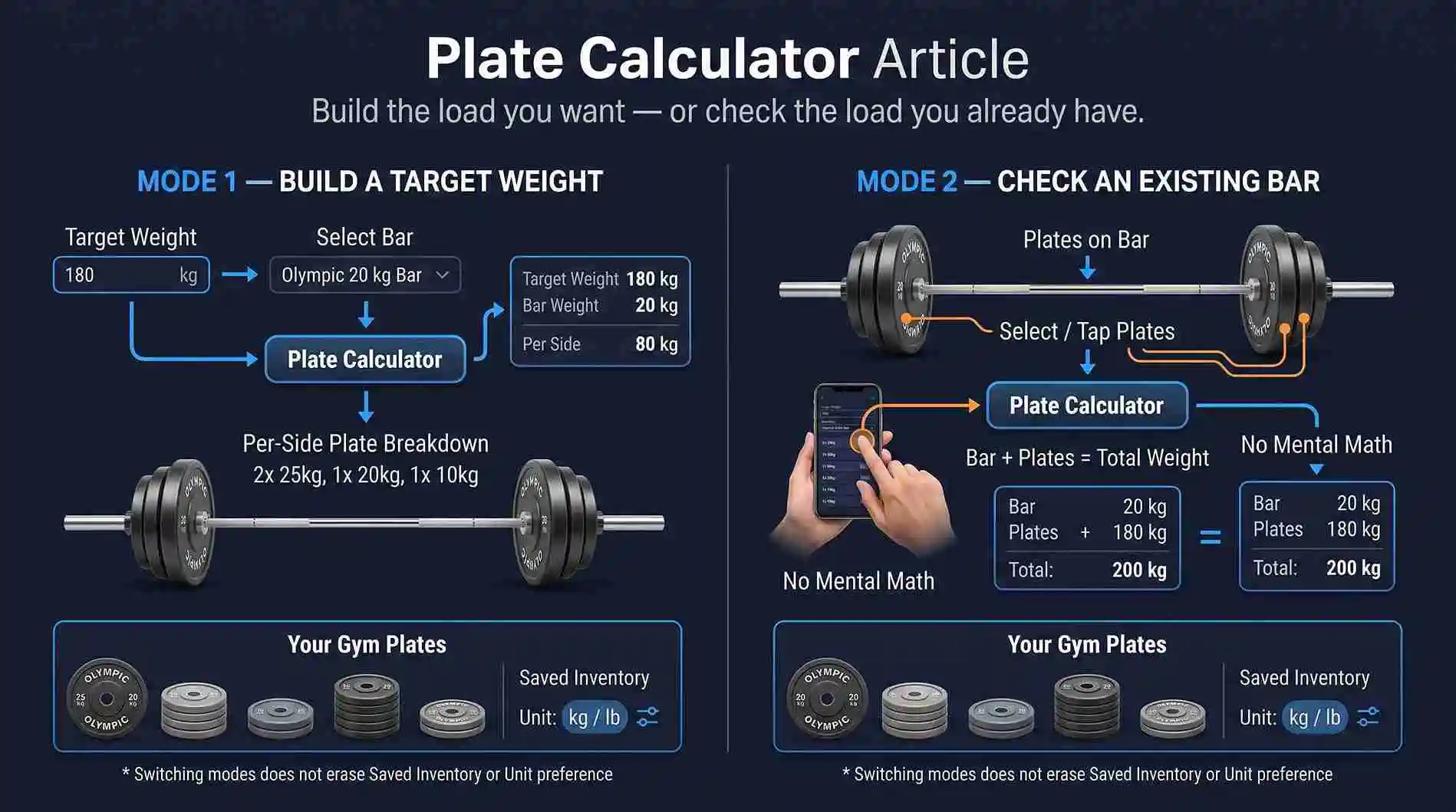
Building a load is simple: put in your target weight, pick your bar, and the plate calculator figures out the per-side breakdown using whatever plates you’ve told it your gym actually has. Don’t touch the default set unless your gym’s rack looks different — once you adjust it, it sticks for next time too.
Going the other way — checking a bar someone else loaded, or double-checking your own — works the same tool, just reversed. Tap the plates you see, and it totals everything including the bar itself. No mental math between sets.
Switching between the two modes doesn’t wipe your saved plate inventory or your unit setting. It’s the same data, just used in whichever direction you need.
Choosing Your Bar Weight
Here’s a mistake that trips people up more than you’d think: getting the bar weight wrong. Doesn’t matter how careful you are with the plates — if the bar number’s off, everything downstream in the plate calculator is off too.
Most gyms run standard men’s Olympic bars at 45 lb (20 kg), and that’s the default assumption almost every calculator makes. Fair enough — it’s right most of the time. But not always:
| Bar Type | Typical Weight |
|---|---|
| Men’s Olympic bar (7 ft) | 45 lb / 20 kg |
| Women’s Olympic bar (6 ft) | 33–35 lb / 15 kg |
| Technique/training bar | 25–33 lb / 10–15 kg |
| EZ curl bar | 15–25 lb / 7–11 kg |
| Trap (hex) bar | 45–75 lb / 20–34 kg |
| Safety squat bar | ~65 lb / ~29 kg |
| Buffalo bar | ~52 lb / ~24 kg |
Treat these as ballpark figures, not gospel — manufacturers don’t all agree, so if your bar’s got a weight stamped on it, trust that over any default.
Plate-loaded machines are their own headache. Leg press, hack squat — there’s no real “bar” at all, just a sled with a starting weight nobody bothers to print anywhere. Most people just set the bar weight to zero and track plates only. Honestly, that’s the smarter move — guessing at sled weight across different machine brands is a good way to end up more wrong than if you’d just ignored it.
Understanding Plate Sizes
Plates come in fairly standard sizes, though what your specific gym stocks can vary.
| Pounds | Kilograms |
|---|---|
| 55, 45, 35, 25, 15, 10, 5 | 25, 20, 15, 10, 5 |
| 2.5, 1.25, 1, 0.75, 0.5, 0.25 | 2.5, 2, 1.5, 1.25, 1, 0.5, 0.25 |
The big plates carry most working sets. The small ones — fractional plates, some people call them “change plates” — exist so you’re not stuck jumping from 225 straight to 235 with nothing in between. If your gym skipped buying these (a lot do), that’s almost always why the calculator can’t land you on an exact number.
Customizing Your Plate Inventory
Not every gym has a full set. Some skip the 55s. Some are kg-only. Home setups are often the most limited of all.
Tell the plate calculator what you’ve actually got, once, and every result after that reflects reality instead of a “perfect gym” fantasy. And if your plates genuinely can’t hit the exact number you typed in, the tool won’t pretend otherwise — it’ll show you the closest it can get, and how far off that is.
What “Plates Per Side” Actually Means
This isn’t complicated math, but it’s worth seeing it laid out instead of just trusting the plate calculator as a black box.
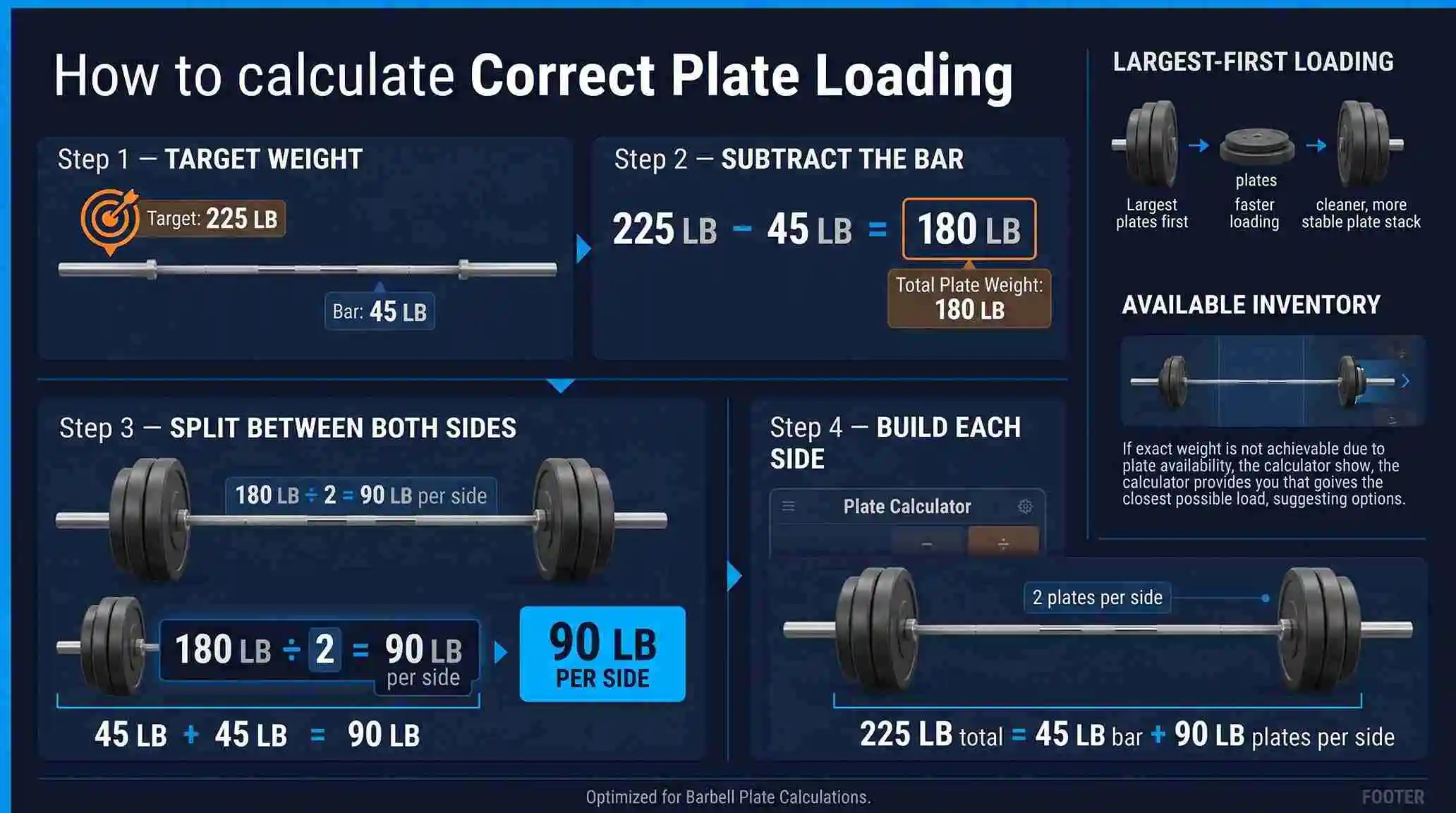
Subtract the bar weight from your target. Split what’s left in half, since both sides carry equal load. Then fill that number using your biggest available plates first, working down to smaller ones.
Example: Target’s 225 lb, bar’s 45 lb. That leaves 180 lb of plates, 90 lb per side. Start big — one 45 gets you to 45, a second gets you to 90. Done. Two plates a side, which is exactly the shorthand lifters already use for 225.
Why largest-first? Fewer plates on the bar means faster loading and a more stable stack — nobody wants to balance six small plates when two big ones do the job. When your inventory can’t make an exact match (missing a small plate size, usually), the calculator still works from the same logic, just landing on the closest number instead of the exact one.
Do Collars Count Toward Your Total?
Something most calculators never mention: collars add weight too, and depending on the type, it’s not nothing.
| Collar Type | Typical Weight (pair) |
|---|---|
| Spring collars | ~1 lb (2 × 8 oz) |
| Clamp/lockjaw collars | ~2 lb (2 × 1 lb) |
| Standard/competition collars | ~10 lb (2 × 5 lb) |
For a casual working set, ignore this — it won’t matter. But if you’re chasing a specific percentage, logging a PR, or prepping for a meet, know which collars your gym uses. Competition-style clamps can add ten extra pounds you weren’t counting.
Common Barbell Loadings (Quick Reference)
The numbers lifters already have memorized, or want to sanity-check fast. Based on a 45 lb / 20 kg bar with standard plates.
Pounds
| Total | Per Side | Plates Per Side |
|---|---|---|
| 135 lb | 45 lb | one 45 |
| 185 lb | 70 lb | 45 + 25 |
| 225 lb | 90 lb | two 45s |
| 275 lb | 115 lb | two 45s + 25 |
| 315 lb | 135 lb | three 45s |
| 365 lb | 160 lb | three 45s + 25 |
| 405 lb | 180 lb | four 45s |
Kilograms
| Total | Per Side | Plates Per Side |
|---|---|---|
| 60 kg | 20 kg | one 20 |
| 100 kg | 40 kg | two 20s |
| 140 kg | 60 kg | three 20s |
| 180 kg | 80 kg | four 20s |
Using Plate Math for Warm-Ups and Percentages
Working sets aren’t the only place this matters. A lot of programs ask for a percentage — 70% of your working weight, 80% of your 1RM — and doing that math on the fly, mid-session, is exactly the kind of thing that eats up rest time and patience.
Easiest fix: multiply your target by the percentage first, then run that number through the calculator like any other target weight. Doesn’t matter if it’s a warm-up or a programmed percentage block — the calculator just needs the final number.
(Don’t know your estimated 1RM yet? Our One Rep Max Calculator can give you that starting point.)
Loading the Bar Safely
A handful of habits keep this from going wrong:
- Match both sides exactly — same plates, same order. An unbalanced bar can genuinely tip when you unrack it.
- Big plates in first, small ones outside. Keeps weight centered and the whole thing feels steadier.
- Use a collar. Every time. Plates shift more than people expect, and a plate sliding off mid-lift isn’t a small inconvenience — it’s a real injury risk.
- Glance at it before a heavy set. Takes two seconds, and it’s the difference between catching a leftover plate from the last person and finding out the hard way.
Limitations of Any Plate Calculator
The plate calculator’s output is only as good as three inputs: your bar weight, what plates you told it you have, and whether you’re including collars. Mess up any of those and the number will still look confident — it’ll just be wrong.
One more thing worth knowing: labeled plate weight and actual plate weight aren’t always the same thing. Calibrated competition plates are pretty tight on tolerance. Cheaper iron or bumper plates can drift a bit. For everyday training it’s a non-issue. For a meet, or a program tracking exact percentages, it’s worth being aware of.
Frequently Asked Questions
Does this work for plate-loaded machines like the leg press?
Yes — set the bar weight to zero if you don’t know the machine’s sled weight, and you’ll get a clean plate-only total. That’s how most people track machine work anyway, since sled weights are rarely labeled and differ by brand.
Why won’t it hit my exact target weight?
Almost always a missing small plate size. The plate calculator will still get you as close as possible and tell you the gap, instead of just failing silently.
Is a 45 lb plate the same as 20 kg?
Close, not identical. A 45 lb plate is about 20.4 kg; a 20 kg plate is about 44.1 lb. Gyms often treat them as interchangeable in conversation, but if you’re converting a programmed number between units, that small gap can add up.