
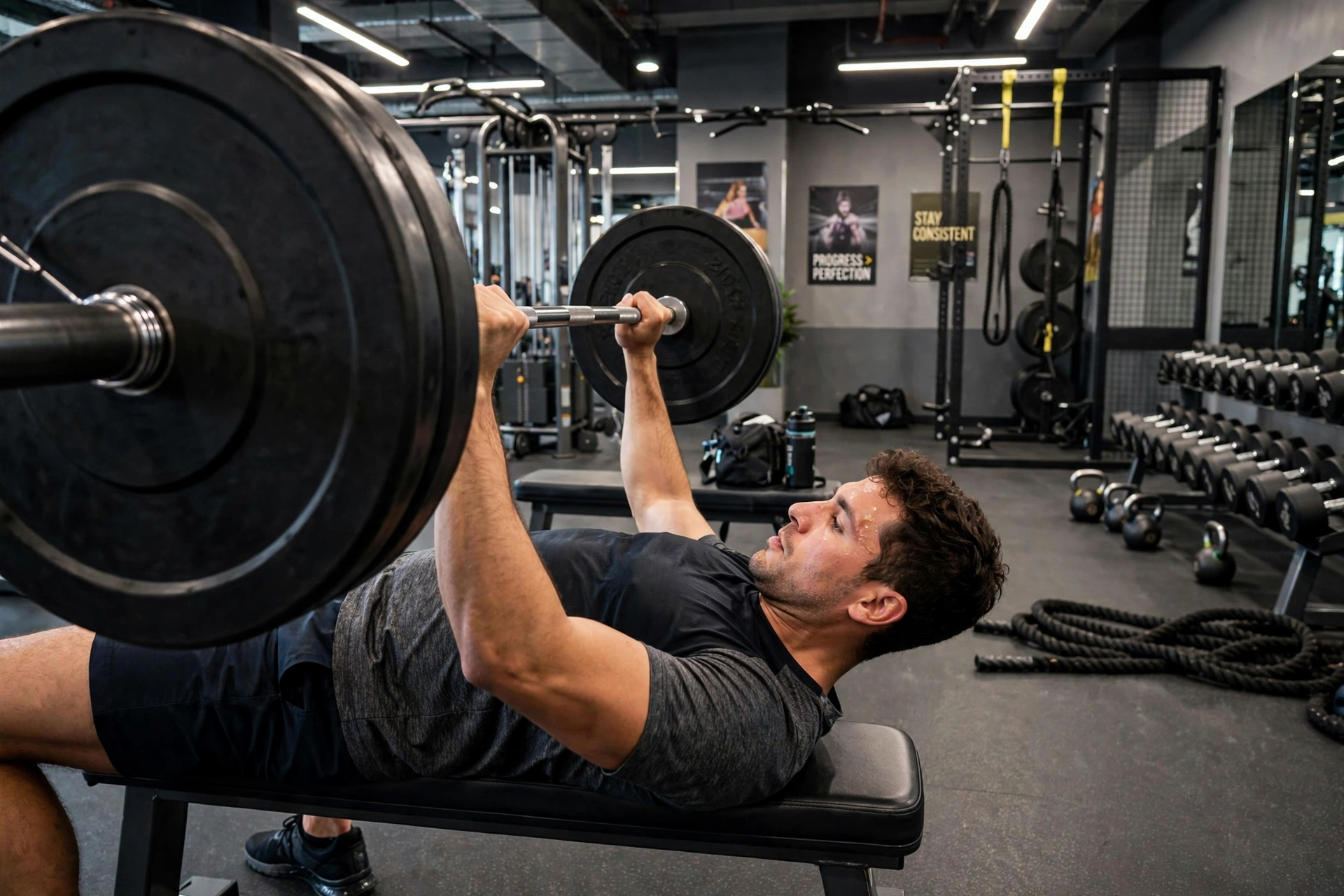
Mayhew Formula: The Bench Press Specialist
The Mayhew formula (Mayhew et al., 1992) estimates your one-rep max as 1RM = 100 × weight ÷ (52.2 + 41.9 × e−0.055 × reps). It earned its reputation in the most important validation study this field has: LeSuer et al. (1997) found it was one of only two formulas whose bench press predictions didn’t differ significantly from actual tested maxes. If you bench, this one deserves your attention.
What is the Mayhew formula?
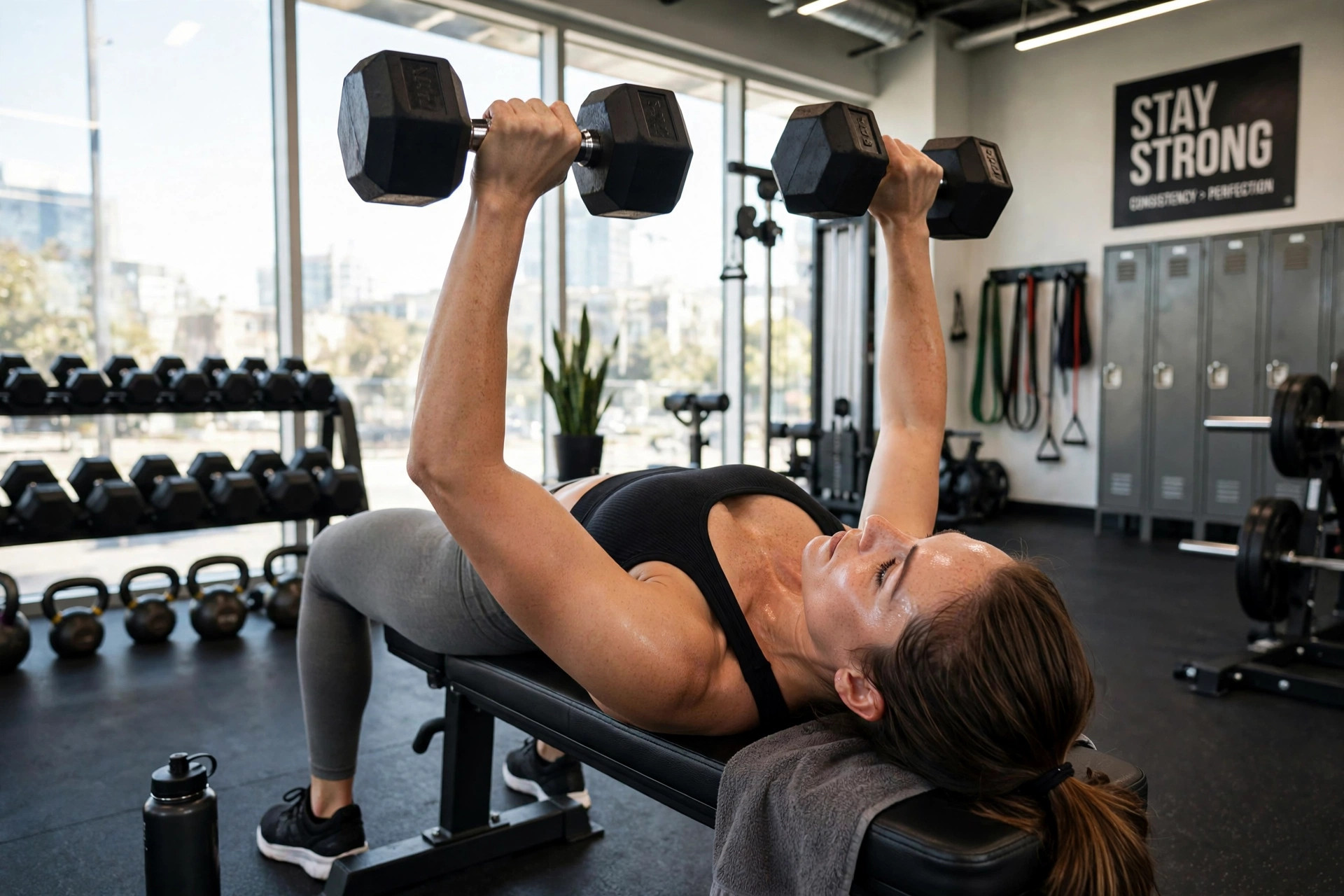
Developed by Mayhew and colleagues in 1992, it’s an exponential-decay model in the same family as Wathan — but with different constants that make it behave distinctly. The headline numbers from 100 kg:
- 1 rep → 108.9 kg
- 5 reps → 119.0 kg
- 10 reps → 130.9 kg
- 15 reps → 141.7 kg
Two things jump out. First, Mayhew runs hotter than the field at 5 reps — 119.0 vs Epley’s 116.7 and Brzycki’s 112.5. Second, that 1-rep figure of 108.9 is the least “honest” of any major formula: it claims your max is nearly 9% above a weight you actually lifted for a single. That’s a quirk to remember, not a dealbreaker — nobody uses a 1-rep set as formula input anyway — but it tells you Mayhew leans optimistic at the very bottom of the rep range.
How does the Mayhew math actually work?
The formula is 1RM = 100 × W ÷ (52.2 + 41.9 × e−0.055R).
Same architecture as Wathan, different personality. The decay constant 0.055 is smaller than Wathan’s 0.075, meaning the curve decays more slowly — the denominator stays larger for longer as reps climb, which… actually, let me put it in lifter terms instead of math terms. The practical effect: Mayhew gives you generous numbers in the low-mid rep range (that’s the 119.0 at 5 reps) but doesn’t explode at high reps the way Brzycki does (141.7 at 15 reps is restrained compared to Brzycki’s 163.6). It’s optimistic where it matters for programming and sane where other formulas lose the plot.
Worked example: 185 lb for 6 reps
- Weight = 185, reps = 6
- Exponent: −0.055 × 6 = −0.33; e−0.33 = 0.7189
- Denominator: 52.2 + 41.9 × 0.7189 = 52.2 + 30.12 = 82.32
- 100 × 185 ÷ 82.32 = 224.72
- Estimated 1RM: 224.7 lb
Compare: Epley would say 222.0 lb and Brzycki 214.4 lb from that set. Mayhew’s the optimist of the three — about 10 lb above Brzycki. Whether that’s a feature or a bug depends on what you do with the number, which I’ll get to.
One more, heavier: 200 lb for 8 reps.
- −0.055 × 8 = −0.44; e−0.44 = 0.6440
- Denominator: 52.2 + 41.9 × 0.6440 = 52.2 + 26.98 = 79.18
- 100 × 200 ÷ 79.18 = 252.59
- Estimated 1RM: 252.6 lb
Why the research likes Mayhew for bench press
This is the part that separates Mayhew from formula folklore. In LeSuer et al.’s 1997 study — 67 untrained college students, seven equations tested against actual bench, squat, and deadlift maxes — Mayhew was one of only two formulas whose bench press predictions did not differ significantly from the real thing. (Wathan was the other.) Every other formula, including Epley and Brzycki, missed by enough to matter statistically.
There’s more. Mayhew et al. followed up in 2008 with 103 women, finding the formula held up well — and notably, accuracy was better under 10 reps, which lines up with everything we know about rep-range reliability generally. I want to be careful here: that’s a finding from one study population, not a universal law. But if you’re a woman estimating from a 5-rep set, Mayhew is a defensible choice with actual data behind it, not just gym lore.
Where does Mayhew shine?
Bench press, 3–8 reps. The research case is specific and I won’t oversell it beyond that. But within that box — the most common lift, the most common rep range — Mayhew has the best validation pedigree of any formula on this site.
Programming training weights. Here’s where the optimism becomes a feature: if you base percentages on a Mayhew estimate, your working weights land a touch higher than Brzycki-based ones. For intermediate lifters who consistently find Brzycki-based programs too easy, Mayhew closes that gap.
Where does it struggle?
That 1-rep quirk. 108.9 from a 100 kg single is just wrong-looking. It doesn’t matter in practice (never plug in a 1-rep set), but it reveals the formula’s optimistic bias at the extreme low end.
Deadlift. Like every formula LeSuer tested, Mayhew underestimated the deadlift — the whole field missed low by 9–14% on pulls. Mayhew’s bench press credentials don’t transfer to the deadlift bar.
Very high reps. At 15+ reps the optimism compounds. Keep test sets at 10 or fewer and Mayhew stays in its validated zone.
How does Mayhew compare to Epley and Brzycki?
At 5 reps from 100 kg: Mayhew 119.0, Epley 116.7, Brzycki 112.5. Mayhew leads by a clear margin — this is the biggest 5-rep spread among the major formulas.
At 10 reps: Mayhew 130.9 vs 133.3 for both Epley and Brzycki. Now Mayhew trails slightly. The crossover is interesting: Mayhew is the high estimator at low reps and the conservative one at 10+.
At 15 reps: Brzycki 163.6, Epley 150.0, Mayhew 141.7. Mayhew is the most restrained of the three up here, which I’d argue makes it the most trustworthy of the three for high-rep input — though Lombardi (131.1) is more conservative still.
My practical take: for bench press programming off 3–8 rep sets, Mayhew is arguably the single best formula choice in existence, because it’s the one with a validation study saying so. For everything else, use it as one vote among several.
Frequently asked questions
Is the Mayhew formula the most accurate?
For bench press specifically, it has the strongest research case — LeSuer et al. (1997) found it one of only two formulas statistically indistinguishable from actual bench maxes. That’s a narrower claim than “most accurate overall,” and I’d keep it that narrow.
Why does Mayhew give higher numbers than Brzycki?
Different curve math. At 5 reps from 100 kg it’s 119.0 vs 112.5 — a 6.5 kg gap from the same set. Neither is “right”; they’re different models. The research suggests Mayhew’s optimism is closer to reality for bench press, at least.
Does Mayhew work for women?
Mayhew et al. tested it in 103 women in 2008 and found it held up, with better accuracy under 10 reps. That’s a genuine study finding, though from one population — I’d treat it as encouraging rather than definitive.
Should beginners use the Mayhew formula?
It’s fine, but beginners’ strength changes fast enough that any formula’s estimate goes stale quickly. Re-test from a fresh 5-rep set every few weeks rather than trusting an old number, whichever formula you use.
Sources
- LeSuer, D.A., et al. (1997). The accuracy of prediction equations for estimating 1-RM performance in the bench press, squat, and deadlift. Journal of Strength and Conditioning Research, 11(4), 211–213.
Learn more