Deadlift Max Calculator
No need to risk a true max attempt. Enter your last solid deadlift set, pick Epley or Brzycki, and this deadlift 1RM calculator gives you an estimated max plus training percentages to build your next few weeks around — tuned specifically for how deadlifts behave, not a generic 1RM tool.
Deadlift 1RM Decision Engine
Enter your deadlift lift details to calculate 1RM, reliability rating, deadlift training loads, and plate breakdown.
💡 RPE / RIR Deadlift Effort Scale Guide ▼
Input is in an optimal low-rep strength zone (1–5 reps) where formula agreement is very high.
* This is an estimate based on weight, reps, scientific formulas, and RIR effort. Actual deadlift 1RM varies with readiness and grip fatigue.
What do you want to do next?
| Percentage | Calculated Load | Est. Rep Range | Training Focus |
|---|
Safety Note: Maintain a neutral spine and disengage safely if lock-out fails.
| Formula Name | Estimated 1RM | Variance vs Recommended |
|---|
Different scientific equations apply unique mathematical models to deadlift rep fatigue curves.
Bodyweight Relative Deadlift Strength Ratio
🎯 Reverse Deadlift 1RM Target Finder ("I want a X Deadlift 1RM") ▼
Log Current Deadlift Lift to Local History
| Date | Deadlift Variation | Weight × Reps | Est. 1RM | Change | Action |
|---|
🧪 Formula Accuracy Calibration (Tested vs Estimated Deadlift Max) ▼
How to Use This Deadlift Max Calculator
Enter the weight you lifted and how many reps you completed with solid form — no bar drift, no hitching the bar off your knees, no rounding your lower back to grind out the last one. The Deadlift Max Calculator works best when those reps represent your actual pulling strength. Two to six reps gives you the most trustworthy number for a deadlift specifically, which we’ll get into below. Hit calculate, and this deadlift calculator returns an estimated one-rep max along with a set of training percentages built directly from that number.
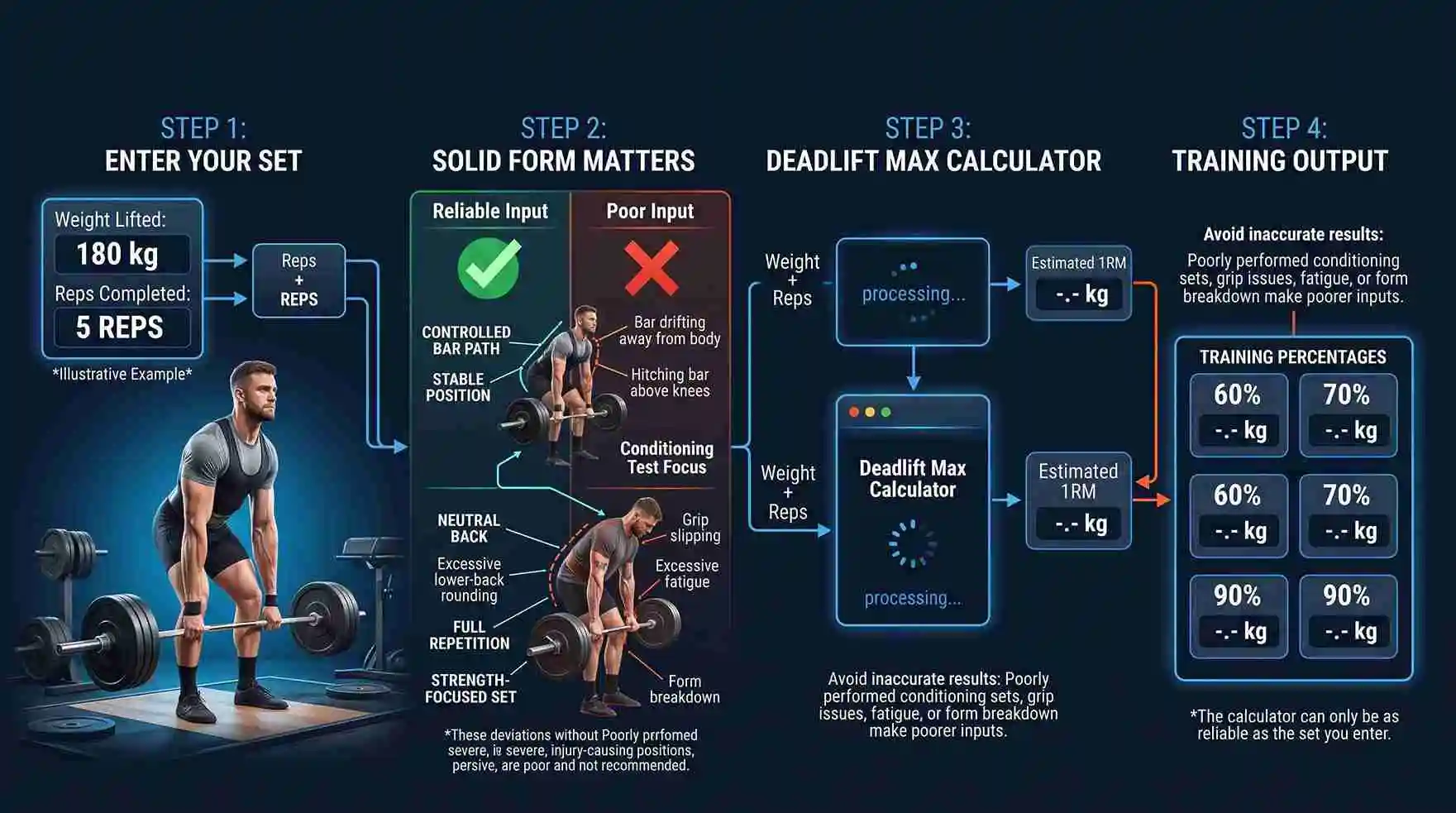
If your set felt more like a conditioning test than a strength test — grip slipping, breathing ragged, form falling apart by rep four — pick a different set to enter. The calculator can only work with what you give it.
What Your Estimated Max Actually Means
Your one-rep max, or 1RM, is the heaviest weight you could lift for exactly one complete repetition with your technique intact. It’s not the same thing as a rep max, which is the most you can lift for some other number of reps — say, a tough set of 5. What a Deadlift Max Calculator does is take that rep max and work backward to a predicted single.
That distinction matters because a predicted number and a tested number aren’t the same thing, even though people often use them interchangeably in conversation. You can find your 1RM two ways: you can actually load a bar and pull a single all-out rep, or you can estimate it from a lighter set using a formula. Most lifters estimate, and for good reason — a true max attempt on a deadlift puts real strain on your spine and nervous system, and it’s simply not something you want to test every week. An estimate from a hard set of 3 to 6 reps gets you close enough for almost every practical training decision, without the recovery cost.
The Math Behind the Number: Epley and Brzycki Formulas
This deadlift max calculator uses one of two well-established formulas, depending on which you select.
Epley: 1RM = weight × (1 + reps ÷ 30)
Brzycki: 1RM = weight × 36 ÷ (37 − reps)
Both formulas take the same two inputs — weight and reps — and project what a single rep at that intensity would look like. At low rep counts they agree closely. Pull 405 lb for 3 reps, and Epley gives you roughly 445 lb while Brzycki gives you roughly 443 lb — a two-pound gap, essentially noise.
The gap widens as reps climb. Take that same 405 lb for 8 reps instead of 3: Epley lands around 513 lb, Brzycki around 486 lb — a 27-pound spread. Neither formula is “wrong.” They’re built on different assumptions about how strength and endurance trade off as fatigue builds, and once you’re deep into a set, those assumptions start to diverge from what’s actually happening in your body. That’s the real reason to keep your input set short rather than long: it’s not that high-rep sets are useless, it’s that the formulas themselves get less reliable the further they have to extrapolate.
Why the Deadlift Doesn’t Play by the Same Rules as Bench or Squat
If you’ve run the same rep count through a bench press calculator and a deadlift calculator, you may have noticed the deadlift result feels less certain — like it’s more of a ballpark than a bench or squat estimate would be at the same rep count. That’s not in your head. Two things make deadlift reps behave differently.
There’s no stretch reflex to reset the rep. On a bench press or squat, the bar changes direction under load — down, then up — and that eccentric-to-concentric transition gives you a small, free assist on the way back up. A deadlift starts from a dead stop on the floor. Every single rep is its own cold start, with none of that elastic carryover. That makes deadlift reps harder to string together consistently, which is part of why lifters can often bench or squat for higher reps than they can pull.
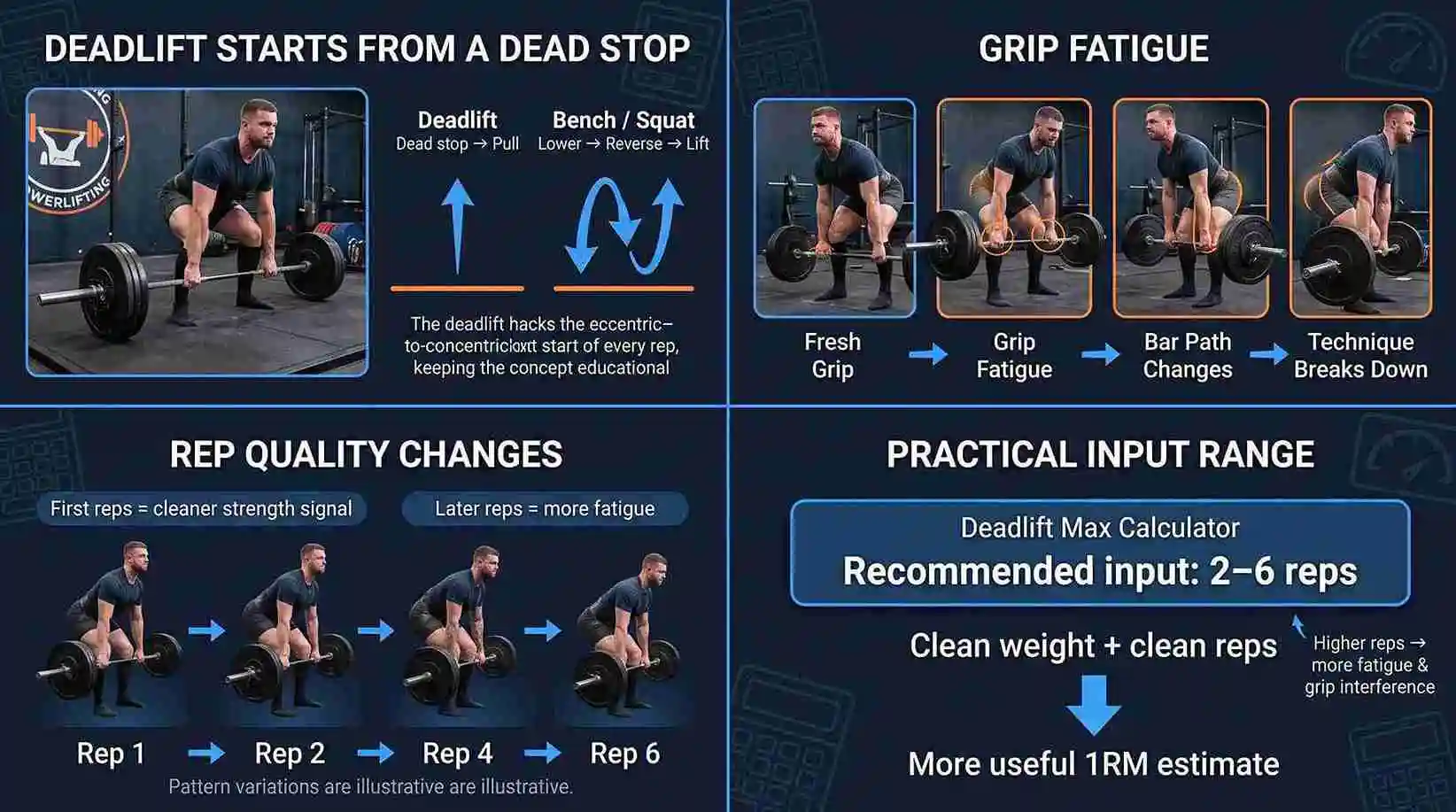
Your grip usually gives out before your legs and back do. On a heavy set of deadlifts, your hands are often the first thing to fail — not your posterior chain. Once your grip starts slipping, your bar path drifts, your hips shift to compensate, and the rep you’re counting toward the calculator isn’t really the same rep as the first one in the set anymore. A formula has no way to know that rep six was mostly a grip battle rather than a strength test, so it credits you with more raw strength than you actually displayed.
Put those two things together and you get a practical rule: keep your deadlift input set to somewhere between 2 and 6 reps. That’s tighter than the roughly 2-to-10 range you’ll see recommended for lifts in general, and it’s tighter specifically because of how deadlifts fail. The first rep in a set is almost always the cleanest one you’ll do — closest to your true strength, before fatigue and grip start editing your technique.
How Accurate Is a Deadlift Max Calculator Compared to a Real Test?
Here’s something most calculators don’t tell you: a formula-based estimate and a genuinely tested one-rep max are not usually identical numbers, even when your input set was clean.
A true max attempt happens under different conditions than a training set. You get a full warm-up built specifically toward that one lift, extended rest between attempts, a spotter or safety setup, and — for a lot of lifters — a mental switch that flips when the weight on the bar is a number they’ve decided matters. Competitive powerlifters routinely pull a competition single that’s higher than what a submaximal-set formula would have predicted from their training numbers, partly because of that setup and partly because peaking for a single heavy attempt is a skill in itself, separate from general strength.
That doesn’t make the calculator’s number wrong. It makes it what it’s designed to be: a conservative, safe planning estimate rather than a prediction of your absolute ceiling under ideal competition conditions. Treat it as the number you build training weeks around, not the number you’d bet your actual max equals to the pound. If you want to know your true tested max, the only reliable way to find it is to actually attempt one — carefully, with a proper warm-up and appropriate supervision.
Turning Your Number Into Training Weights
Once you have an estimated max from the Deadlift Max Calculator, the useful next step is converting it into weights you’ll actually load for specific training goals. Deadlifts respond a little differently to percentage-based programming than presses do — most coaches keep deadlift volume work at a somewhat higher percentage and lower rep count than they would for bench or squat, because grinding out long, gritty deadlift sets tends to cost more recovery than it’s worth.
Percentage Table
| % of 1RM | Typical Reps | Training Focus |
|---|---|---|
| 90–100% | 1–2 | Peak strength, competition prep |
| 80–90% | 3–5 | Max strength, low-volume heavy work |
| 70–80% | 5–8 | Strength with moderate volume |
| 60–70% | 8–10 | Technique work, speed pulls |
Say your calculator estimate comes out to 405 lb. A strength-focused session might have you working at 85% — around 344 lb — for sets of 3 to 5, with long rest between them. A technique or speed session might sit closer to 65%, around 263 lb, prioritizing bar speed and clean positioning over grinding reps. The percentage isn’t a rule carved in stone; it’s a starting point you adjust based on how the bar actually moves that day.
Conventional, Sumo, Trap Bar, and Romanian Deadlift Aren’t the Same Max
If you only ever pull one style of deadlift, you can skip this section. If you train more than one, it matters: each variation changes your leverage enough that they should be tracked as separate numbers, not converted from one to another.
Conventional is the standard reference point — feet roughly hip-width, hands outside the legs. It typically demands the most from your lower back and upper back to keep the bar close through a longer range of motion.
Sumo uses a wider stance with your hands inside your knees. For most lifters this shortens the pull and shifts more of the work onto the hips and adductors. Many lifters can move more weight sumo than conventional — but that’s a difference in leverage, not a sign that one style is “the real” deadlift and the other is a shortcut.
Trap bar (hex bar) changes the bar path itself. Because you stand inside the bar rather than behind it, your torso stays more upright and the load sits closer to your center of mass. That usually lets people move more weight than they would with a straight bar, which makes a trap bar 1RM estimate a poor stand-in for a straight-bar deadlift max — they’re related lifts, not the same lift.
Romanian deadlift (RDL) isn’t really a max-strength test at all in the same sense. It’s a controlled hip hinge with a deliberate stop above the floor, and what usually limits your load is hamstring flexibility and position control rather than raw pulling strength. You can absolutely run an RDL working set through this calculator to get a rep-max estimate for programming purposes, but don’t read that number as your deadlift 1RM.
Common Mistakes That Throw Off Your Estimate
A handful of things reliably inflate or distort a deadlift 1RM estimate. If your number seems off, check for these first before assuming the formula is broken.
- Bouncing or touch-and-go reps. Letting the bar bounce off the floor between reps borrows momentum you won’t have on a true dead-stop single, which inflates your rep count and, with it, your estimate.
- Letting your lockout standard slip. If your knees or hips aren’t fully extended on the later reps, you’re counting partial reps as full ones.
- Testing after heavy squats or a long session. Fatigue carryover from earlier work can drop your deadlift performance by a meaningful margin, which will make even a clean set undersell your actual strength that day.
- Rounding your lower back to squeeze out one more rep. Beyond the injury risk, a rep performed with breakdown in your spinal position isn’t representative of your working strength — it’s a different, riskier movement wearing the same name.
- Retesting too often. Running a new estimate every session adds noise without adding useful information. Give yourself real time — weeks, not days — to actually get stronger between checks.
Frequently Asked Questions
How many reps should I use for the most accurate deadlift estimate?
Somewhere between 2 and 6 clean reps. That’s tighter than the general 2-to-10 guidance you’ll see for lifts overall, because deadlifts lose reliability faster as grip and positioning start to slip on later reps.
Should I use Epley or Brzycki in a deadlift max calculator?
Both are reasonable choices, and they’ll give you nearly identical numbers at low rep counts. If you want a slightly more conservative estimate — useful if you’d rather plan training weights on the safe side — Brzycki tends to run a touch lower once you get past 5 or 6 reps.
Why does my deadlift estimate feel less reliable than my bench or squat estimate at the same rep count?
Because the deadlift starts from a dead stop with no stretch reflex, and grip fatigue often ends the set before your legs and back reach their real limit. Both effects make higher-rep deadlift sets a less accurate window into your true strength than the same rep count on a press.
Is my sumo deadlift max the same as my conventional max?
No. They’re different lifts with different leverage, and treating one as a stand-in for the other will give you a misleading picture of your progress. Track them separately.
How often should I retest my deadlift max?
Every 4 to 8 weeks is a reasonable default for most training programs, or sooner if you’ve clearly hit a new level of performance — for example, completing more reps at a weight that used to be your limit. Testing weekly adds noise, not clarity.
Will my estimated max match a real tested single?
Not exactly, and that’s expected. A formula estimate from a deadlift max calculator is a conservative planning number. A true tested max benefits from a dedicated warm-up, full rest, and often a mental edge that a training set doesn’t carry — so a genuine max attempt frequently comes in a bit higher than the calculator’s prediction.