
Women’s Strength Standards: What’s a Good Lift for Women?
What’s a good bench press for a woman? Roughly 0.65 times your bodyweight puts you solidly in intermediate territory, and pressing your full bodyweight is genuinely strong — fewer women than you’d think ever get there. These are community-consensus benchmarks, not lab science, but they’ll tell you honestly where you stand.
Why Are Women’s Strength Standards Different From Men’s?
I’ve coached enough lifters to know the pattern by heart: the gap between men and women is biggest on the bench and smallest on the deadlift. That’s not opinion — it’s what every strength-level aggregator and coaching dataset shows, year after year.
The reason is straightforward. On average, men carry a larger share of their muscle in the upper body, while women’s muscle mass is distributed more evenly, with relatively stronger lower bodies. So a woman’s squat and deadlift sit closer to men’s numbers (roughly 70–75% of male standards), while her bench lands further back (roughly 60–65%).
None of this is a value judgment. Ratios are ratios — they just describe where the bar sits so you can measure yourself against something real instead of against the guy grunting two benches over.
What Are Good Bench Press Numbers for Women?
The bench is where honesty matters most, because it’s the lift where inflated gym numbers are most common. These ratios assume a competition-style bench: bar to chest, brief pause, no bouncing.
| Tier | Bench ÷ Bodyweight | What It Means |
|---|---|---|
| Beginner | 0.45× | First 6–12 months of consistent training |
| Intermediate | 0.65× | A couple of solid years; most regular gym-goers land here |
| Advanced | 0.95× | Years of structured programming; approaching bodyweight |
| Elite | 1.25× | Competitive powerlifter territory |
Example: where does a 150 lb bench land?
Take a 150 lb woman benching 95 lb for a single. That’s 95 ÷ 150 = 0.63× bodyweight — right at the intermediate line. If she presses 150 lb (a full bodyweight bench), she’s at 1.0×, solidly advanced and stronger than the vast majority of women who train. That’s a number worth being proud of.
If your bench feels stuck, it’s worth checking your estimate itself — most people test with too many reps. Our bench press calculator will give you a cleaner number, and this breakdown of calculator accuracy explains why high-rep sets inflate predictions.
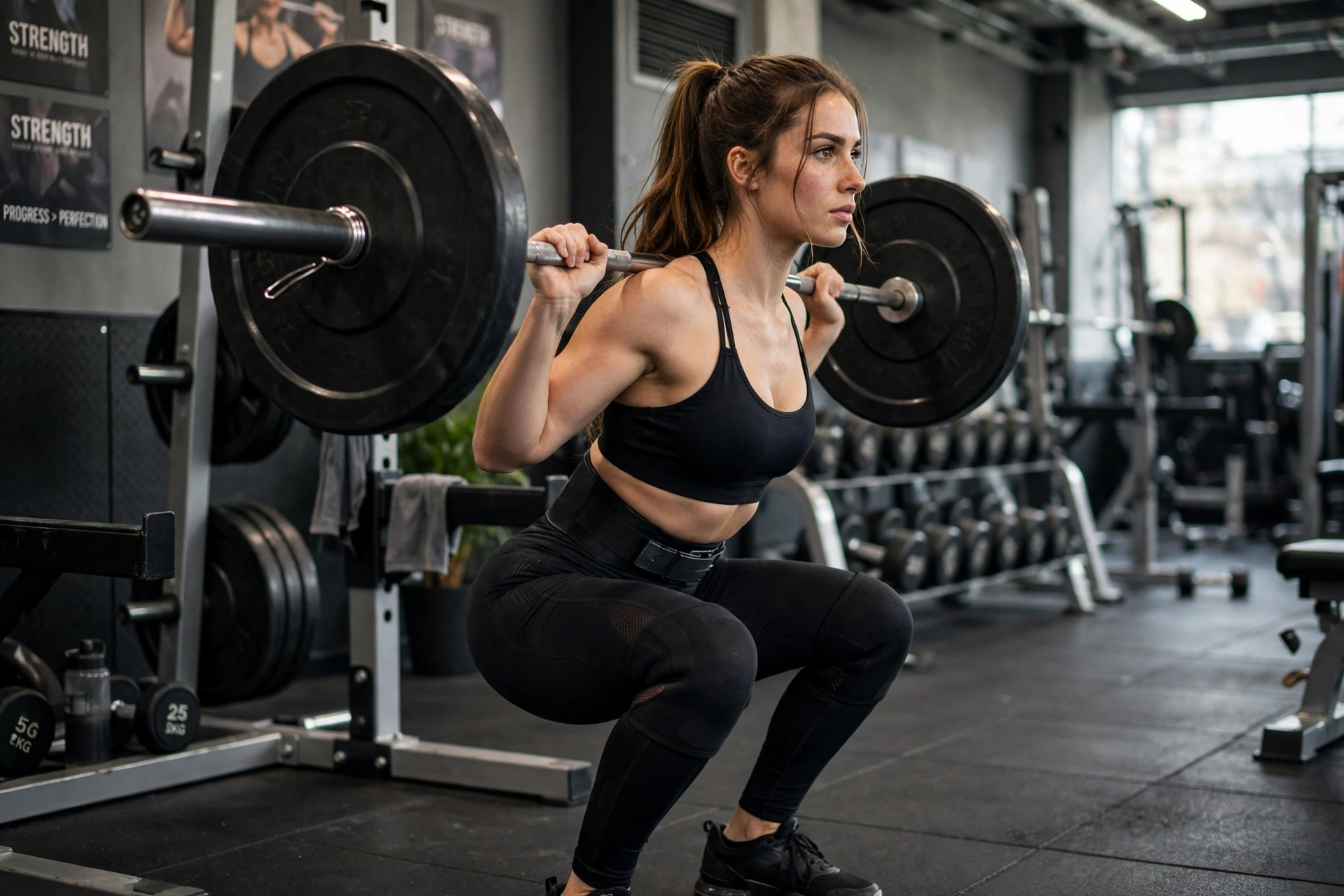
What Are Good Squat Numbers for Women?
The squat is where many women close the gap fast. Relative lower-body strength is the great equalizer, and I’ve seen women out-squat men who outweigh them within two years of training.
| Tier | Squat ÷ Bodyweight | What It Means |
|---|---|---|
| Beginner | 0.75× | Learning the movement, building the base |
| Intermediate | 1.0× | A bodyweight squat — a real milestone |
| Advanced | 1.5× | Serious, consistent training for years |
| Elite | 1.8× | National-level competitor range |
The depth rule still applies
These numbers assume a proper squat — hip crease below the knee. A quarter-squat “1.5× bodyweight” doesn’t count, and you know it doesn’t count. Film a set from the side; most people are surprised. A true 1.0× bodyweight squat to depth beats a fake 1.5× every time, and it keeps your knees and back honest.
What Are Good Deadlift Numbers for Women?
The deadlift is typically a woman’s strongest lift relative to bodyweight, and the standards reflect it. If you want one lift to feel powerful, this is the one.
| Tier | Deadlift ÷ Bodyweight | What It Means |
|---|---|---|
| Beginner | 1.0× | Pulling bodyweight off the floor |
| Intermediate | 1.4× | Respectable pull; most dedicated lifters reach this |
| Advanced | 1.8× | Years of smart training |
| Elite | 2.25× | Competitive powerlifter territory |
One caveat worth knowing: research (LeSuer et al., 1997) found that 1RM formulas consistently underestimate the deadlift by 9–14%. So if your calculator says 200 and you pull 215 on test day, the math wasn’t wrong — the deadlift just responds better to a true max attempt than to rep-based math. Our deadlift calculator is still the best starting point; just know test day usually beats the estimate.
What About Overhead Press?
The strict overhead press is the humbling lift for everyone, and the gender gap here looks like the bench gap — upper-body pressing is upper-body pressing.
| Tier | OHP ÷ Bodyweight | What It Means |
|---|---|---|
| Beginner | 0.30× | First year of pressing |
| Intermediate | 0.45× | Solid, consistent pressing |
| Advanced | 0.65× | Years of dedicated overhead work |
| Elite | 0.85× | Exceptional pressing strength |
How Do I Actually Use These Standards?
Pick your bodyweight, pick your lift, divide. That’s the whole method. Here’s how it plays out in practice:
Worked example 1: the returning lifter
A 140 lb woman squats 185 lb. Ratio: 185 ÷ 140 = 1.32×. That sits between intermediate (1.0×) and advanced (1.5×) — closer to advanced. She should train like an intermediate-advanced lifter: structured programming, planned progression, not beginner linear gains anymore.
Worked example 2: the new lifter
A 165 lb woman deadlifts 135 lb. Ratio: 135 ÷ 165 = 0.82× — below the 1.0× beginner line. Totally normal for month three. The standard tells her she’s exactly where she should be, and that pulling bodyweight (165 lb) is the next real milestone to chase.
Worked example 3: checking balance
A 130 lb woman benches 85 lb (0.65×, intermediate) but squats 95 lb (0.73×, beginner). Her upper body is ahead of her lower body — unusual, and usually a sign the squat has room to run. Standards are most useful this way: not as grades, but as diagnostics.
Do These Standards Change How Women Should Train?
Short answer: no. The principles don’t care about your gender. Progressive overload works the same, recovery works the same, and the lifts are the same lifts.
What does change is the loading math. A woman pressing 0.65× bodyweight for reps is working just as hard, relatively, as a man pressing 1.0× — and her program should be built off her numbers, not his. That’s what your one-rep max is for: it individualizes every percentage, every working set, every progression scheme to you.
Two practical notes from coaching experience. First, many women can handle slightly higher training volumes and recover a bit faster between sessions at the same relative intensity — so don’t be afraid of an extra back-off set. Second, upper-body lifts often need more patience: the bench responds to consistent, boring volume over months, not heroics. Both are tendencies, not rules. Your logbook is the final authority.
A Note on These Numbers
Let me be straight about what these tables are: community-consensus benchmarks compiled from coaching datasets and strength aggregators. They’re not from a single peer-reviewed study, and no universal authority certifies them. What they are is the collective experience of thousands of lifters, and they line up remarkably well across sources.
Three things skew ratios, so adjust expectations accordingly. Lighter lifters hit higher ratios more easily (a 110 lb woman benching bodyweight is less rare than a 180 lb woman doing it). Taller lifters with long arms will find the bench harder and the deadlift easier — levers matter. And age shifts everything: as a rough rule of thumb, expect about 90% of open standards in your 40s and 80% in your 50s, declining gradually from there.
Frequently Asked Questions
Is a bodyweight bench press good for a woman?
Yes — genuinely impressive. A 1.0× bodyweight bench puts a woman in the advanced tier, ahead of the large majority of women who lift. It’s a milestone worth celebrating and a sign of years of consistent work.
Why is the bench gap bigger than the squat gap between men and women?
On average, men carry proportionally more muscle in the upper body, while women’s muscle distribution favors the lower body relatively. So pressing strength shows the biggest gap (~60–65% of men’s standards) and squatting/deadlifting the smallest (~70–75%). It’s anatomy, not effort.
Should women train differently than men?
The core principles are identical: progressive overload, compound lifts, planned progression, adequate recovery. Programs should be built off your own 1RM numbers, not scaled-down versions of someone else’s. Individual response varies more than gender averages do.
Do these standards apply to older women?
Approximately, with an age adjustment. A common coaching rule of thumb: expect roughly 90% of open standards in your 40s and 80% in your 50s, declining gradually after that. Consistency matters more than the exact multiplier — a 55-year-old woman still training beats every chart.
I’m much lighter (or heavier) than average — do the ratios still work?
Roughly, but with a known skew: lighter lifters achieve higher bodyweight ratios more easily, and heavier lifters find them harder. If you’re 110 lb and benching 0.75×, you’re doing great even though the table says “intermediate.” Use the tiers as guides, not verdicts.
Sources
- LeSuer, D.A., et al. (1997). “The accuracy of prediction equations for estimating 1-RM performance in the bench press, squat, and deadlift.” Journal of Strength and Conditioning Research, 11(4), 211–213.
Learn more