

Bench Press Strength Standards: What’s a Good Bench Press?
A good bench press is measured against your bodyweight, not the bar. For men, pressing your bodyweight is a solid intermediate milestone, 1.5× bodyweight is advanced, and 2× is elite territory. For women, the same tiers run roughly 65% of those numbers. Below is the full breakdown — plus why your arm length might matter more than your program.
What is a good bench press for my bodyweight?
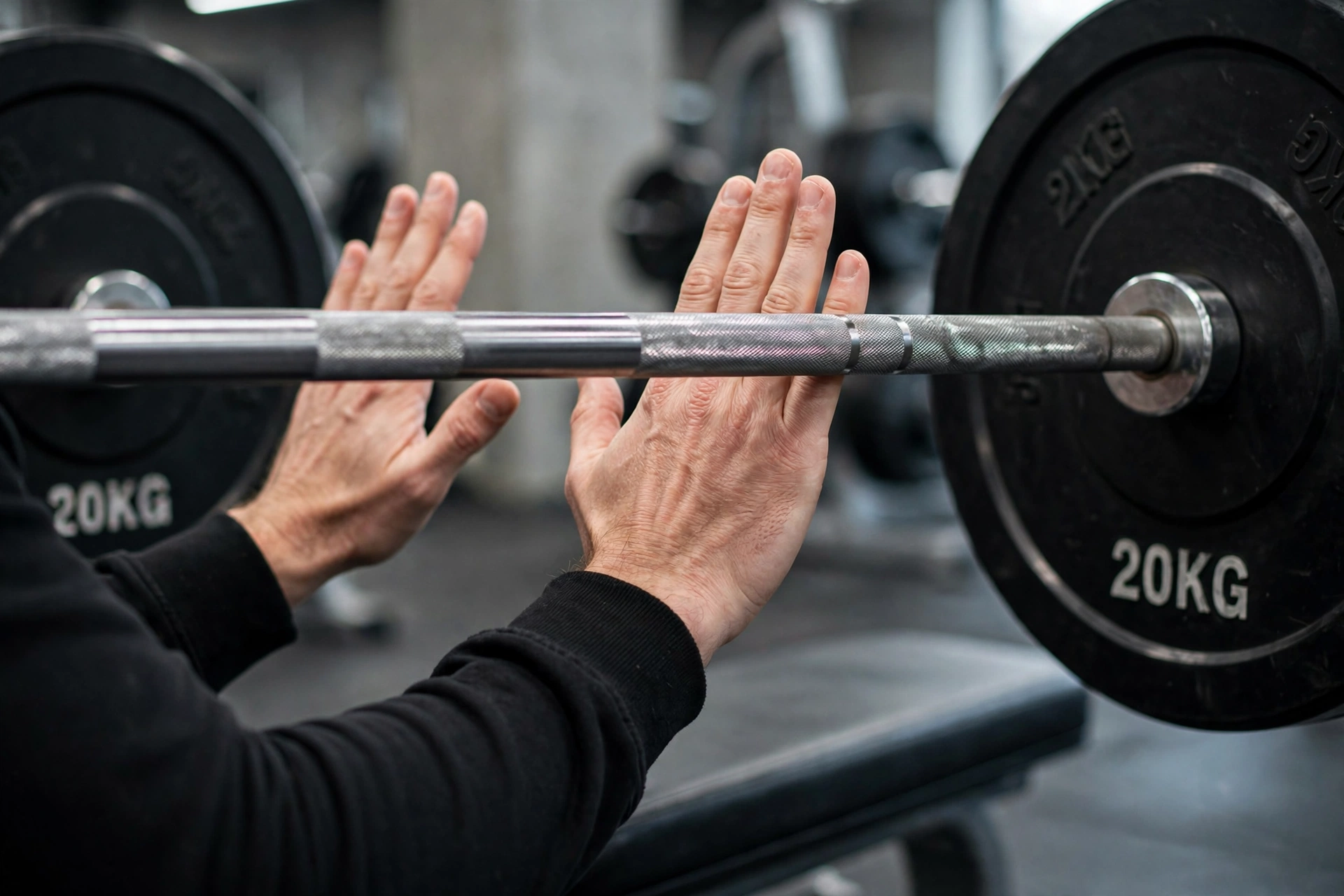
Forget absolute numbers. A 225-lb bench means completely different things for a 150-lb lifter and a 250-lb lifter. Strength coaches have used bodyweight ratios for decades because they’re the only fair way to compare across sizes. The tiers below are community-consensus benchmarks — aggregated from widely published coaching standards, not lab-derived norms. Treat them as orientation, not verdicts.
| Tier | Bench (× bodyweight, men) | Bench (× bodyweight, women) | Example: 180-lb man |
|---|---|---|---|
| Beginner | 0.75× | 0.50× | 135 lb |
| Intermediate | 1.0× | 0.65× | 180 lb |
| Advanced | 1.5× | 1.0× | 270 lb |
| Elite | 2.0× | 1.3× | 360 lb |
Read your tier honestly. Most guys who’ve trained consistently for a year or two land somewhere between 0.85× and 1.1×. If you’re there, you’re doing fine — that’s the broad middle of the lifting population, not a failure to launch.
How do the strength tiers actually break down?
Beginner (0.75× bodyweight)
This is roughly where a healthy adult male lands after a few months of consistent pressing — think 135 lb at 180 lb bodyweight. Nothing to be embarrassed about. Everybody starts here, and the weights move fast at this stage because your nervous system is learning the movement as much as your muscles are growing.
Intermediate (1.0× bodyweight)
The bodyweight bench. This is the milestone that actually means something — it typically takes one to three years of real training. If you can press what you weigh for a clean single, you’re stronger than the large majority of people who’ve ever touched a barbell. Most lifters who train seriously but not competitively live here for years, and that’s a perfectly good place to be.
Advanced (1.5× bodyweight)
Now we’re talking about dedicated programming — 270 lb at 180 lb bodyweight. This usually demands several years of structured training, attention to technique, and probably some coaching. You’ll find lifters at this level handling real volume and thinking about periodization, not just showing up and pressing.
Elite (2.0× bodyweight)
A double-bodyweight bench is rare air — 360 lb at 180 lb. This is competitive powerlifter territory, and genetics starts mattering a lot. If you get here, you already know everything on this page.
Why do bench press standards vary so much lifter to lifter?
Two lifters, same bodyweight, same program, wildly different benches. Here’s why the ratios are ranges, not laws.
Arm length and leverages
This is the big one nobody can train around. Long arms mean a longer bar path on every rep — more distance, more work, lower numbers. A lifter with short arms and a thick torso is built to bench; a lifter with long arms is built to deadlift. I’ve seen 6’3″ guys grind for years to hit a bodyweight bench that a 5’7″ lifter hits in eighteen months. Same effort, different skeletons. Compare yourself to your past self, not to someone with different levers.
Arch and setup
A bigger arch shortens the range of motion, which moves more weight. A moderate arch is legitimate — it puts your shoulders in a safer position — but know that standards assume a competition-legal setup: butt on the bench, feet on the floor. If your “1.2× bodyweight” bench involves a six-inch arch and a bounce, the ratio is flattering you.
Paused vs. touch-and-go
A paused bench typically runs about 95% of touch-and-go for most lifters. Standards are usually written with competition-style paused reps in mind. If all your training is touch-and-go, shave roughly 5% off before comparing yourself to the table — or better yet, test a paused single and use that number.
How do I find my tier from my 1RM?
Simple division. Take your best clean single (or your estimated 1RM from the bench press calculator) and divide by your bodyweight.
Example 1: You weigh 200 lb and bench 225. That’s 225 ÷ 200 = 1.13× — solidly intermediate, knocking on advanced.
Example 2: You weigh 165 lb and bench 185. That’s 185 ÷ 165 = 1.12× — same tier as Example 1, even though the bar weight is 40 lb lighter. This is exactly why ratios beat absolute numbers.
Example 3: You weigh 150 lb and bench 95. That’s 95 ÷ 150 = 0.63× — beginner tier, which is completely normal in year one. The jump from 0.63× to 1.0× is where most of the fun is.
If you haven’t tested a true single, estimate from a 3–5 rep set taken close to failure — that’s the range where predictions are tightest. Anything above 10 reps gets speculative fast.
What are good bench press standards for women?
The women’s column in the table runs about 65% of the men’s ratios, which matches what you see in competition data across weight classes. A bodyweight bench (1.0×) is an advanced milestone for women — genuinely impressive — while 0.65× is a strong intermediate mark.
One thing worth knowing: upper-body strength responds to the same programming as lower-body strength, but many women are under-coached on bench technique specifically — setup, arch, leg drive. Fixing those three things often adds 10–20 lb before any actual strength is gained. The ratio isn’t destiny; it’s a starting point for the conversation.
How do I move up a tier?
The honest answer depends on where you are. From beginner to intermediate, almost any consistent pressing — three times a week, adding a little weight — gets you there. The body adapts fast when everything is new.
From intermediate to advanced is where programming starts mattering. This is the stretch where lifters stall for a year doing the same 3×10 and wonder why. The fix is usually variation: heavier low-rep work, paused reps, close-grip as an accessory, and actually tracking your estimated max over time instead of guessing. If your e1RM trend line is flat for three months, your program — not your effort — is the problem.
From advanced to elite, you’re in coaching, peaking, and patience territory. There’s no shortcut paragraph for that jump.
Frequently Asked Questions
Is a 225-lb bench press good?
Depends entirely on your bodyweight. At 225 lb bodyweight, it’s a 1.0× intermediate bench — solid. At 180 lb, it’s 1.25× — genuinely strong. At 150 lb, it’s 1.5× — advanced. The bar weight alone tells you almost nothing.
What is a good bench press for a beginner?
Around 0.75× bodyweight for men, 0.5× for women — roughly 135 lb at 180 lb bodyweight. If you’re there within your first six months of consistent training, you’re on a normal curve.
How long does it take to bench your bodyweight?
Typically one to three years of consistent training for men. Long-armed lifters should expect the longer end of that range — it’s physics, not a character flaw.
Does the bench press calculator account for arm length?
No — and neither does any formula. Every 1RM equation assumes an average lifter. If your leverages are unusual, treat the estimate as a starting point and calibrate against your actual tested singles over time.
Should I compare my gym bench to powerlifting standards?
Only if your gym bench would pass in competition: paused, butt down, feet flat. If not, you’re comparing two different lifts. Either standardize your setup or take your tier with a grain of salt.
A note on these numbers
No lab study defines “intermediate” or “advanced” — these tiers are community-consensus benchmarks aggregated from decades of published coaching standards. They’re useful for orientation and goal-setting, not for judging your worth as a lifter. Individual variation (leverages, training history, age) easily swings a tier in either direction. The most honest standard is always your own trend line: is today’s number bigger than last year’s?