Overhead Press 1RM Guide: How to Estimate Your Strict Press Max
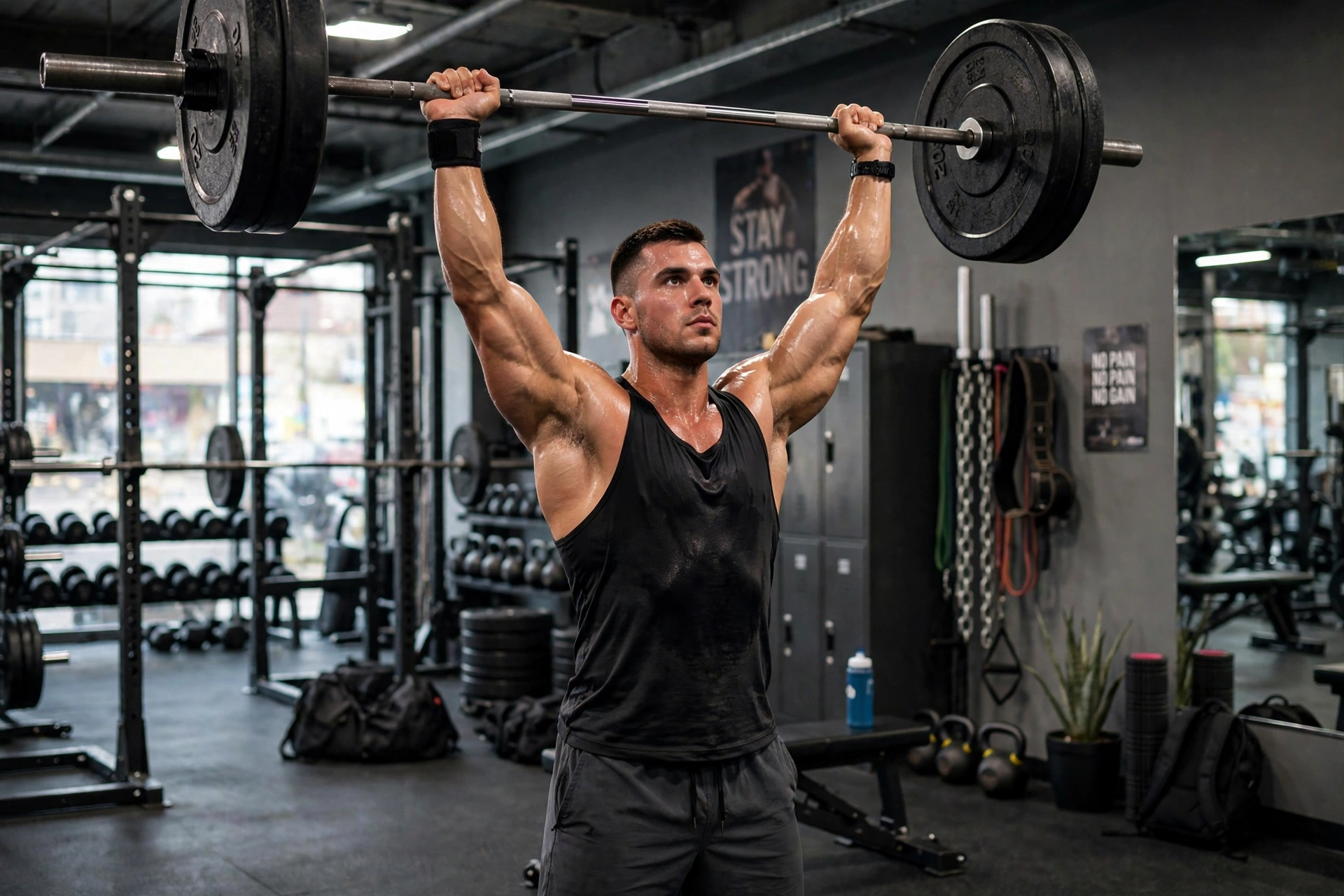
The overhead press is the purest upper-body strength test — no bench to lie on, no leg drive to hide behind. Estimate it like everything else: a 3-to-5 rep strict set through Epley. Example: 135 lb × 5 works out to about 157.5 lb.
What’s the difference between strict press and push press for estimation?
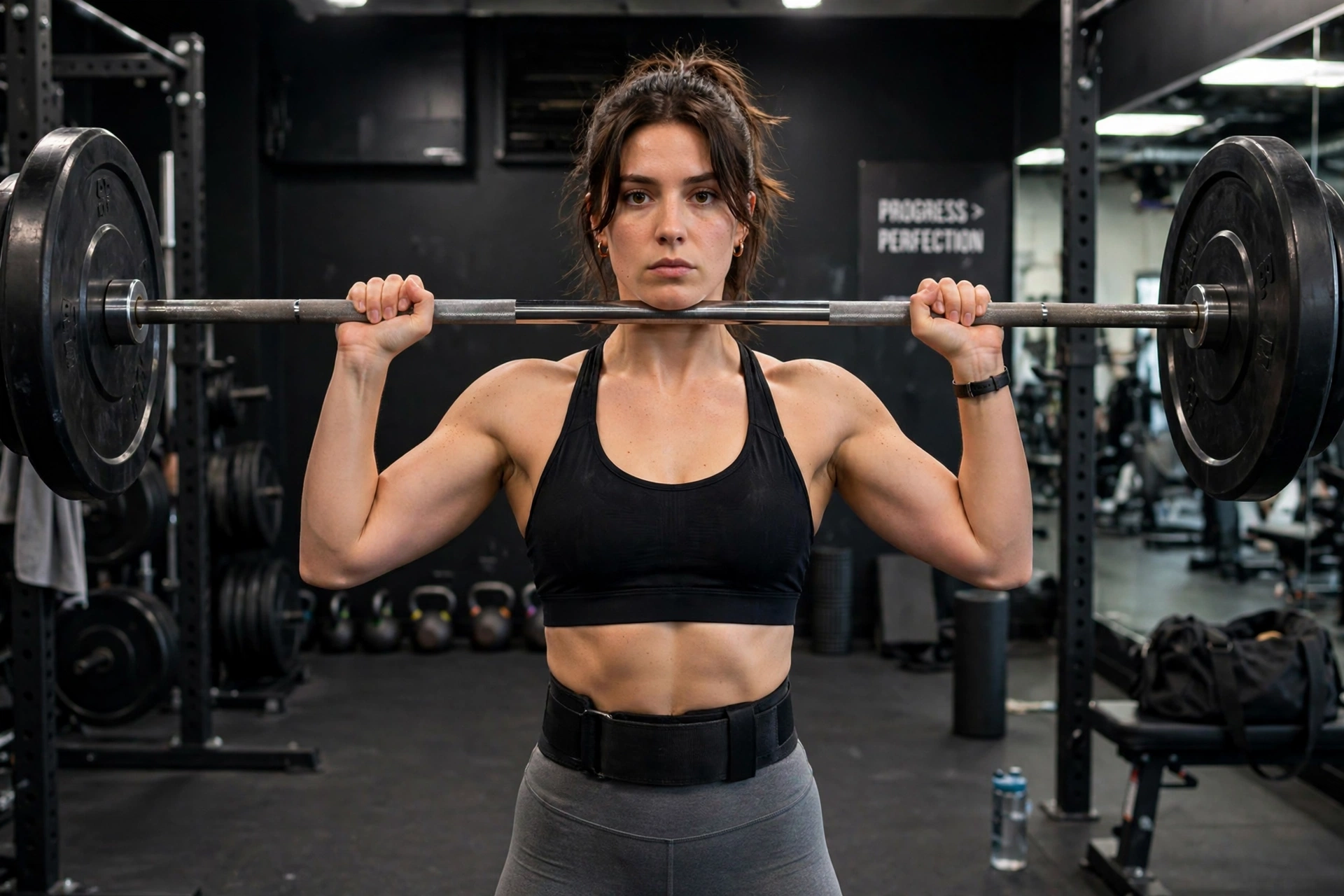
They’re different lifts and they need different estimates. A strict press — no knee bend, no layback beyond what’s natural — is pure pressing strength. A push press adds leg drive, which typically contributes something like 10–30% depending on how good your dip-and-drive is. That’s an observed range across lifters, not a formula, and the spread is exactly why you can’t convert between them with math.
The formulas don’t know your knees bent. Feed a push press set into the calculator and it’ll hand back a number that has leg drive baked in — then you’ll try to strict-press it and wonder what went wrong. Test strict, estimate strict. If you push press, estimate that separately and label it honestly.
Why is the overhead press the hardest lift to estimate?
Small muscles, long lever arm, zero margin for technical sloppiness. The pressing muscles — delts, triceps, upper chest — are a fraction of the mass involved in a squat or deadlift, so small absolute changes in strength show up as big percentage swings. A 5-lb improvement on a 150-lb press is meaningful progress; the same 5 lb on a 400-lb deadlift is noise.
Technique sensitivity compounds it. A little extra layback, a slightly forward bar path, soft glutes — each one leaks pounds, and the leaks vary rep to rep. The calculator assumes every rep cost the same effort. On overhead press, that assumption is shakier than on any other lift, which is why OHP estimates deserve wider error bars and more conservative programming.
Standing or seated — does it matter?
Yes. Standing is the standard for a reason: it demands full-body bracing — glutes, abs, upper back — and that bracing is part of the lift. Seated pressing, especially with back support, removes the stability requirement and usually lets you handle more weight.
How much more varies, but the direction doesn’t: the same lifter almost always seated-presses more than they strict-press standing. Estimate the version you train. If you do both, they’re two lifts with two numbers, same as high-bar versus low-bar squat.
What’s the best rep range for estimating OHP?
Three to five reps, strict, standing, no grindy layback. Same prescription as the other lifts, but the reasoning is sharper here: OHP form degrades faster across a set than bench or squat form does. By rep 8, most lifters are doing a different lift than rep 1 — more layback, more leg bounce, shorter effective range.
Keep test sets short and the estimate stays honest. If you want conditioning, do high-rep pressing as assistance work and don’t feed it to the calculator.
Worked example: 135 lb × 5
Epley: 135 × (1 + 5 ÷ 30) = 135 × 1.1667 = 157.5 lb. There’s your estimated strict press max.
Now be conservative with it. Because OHP estimates run twitchy, I’d program off 150 rather than 157 — take the estimate, knock off 5%, and call that your training max. On a lift where a bad day costs you 10 lb, that buffer is the difference between productive training and a month of missed reps.
And the push press version of the same lifter? If their leg drive is decent, that 135 × 5 strict set suggests a push press somewhere in the 170–185 range. Don’t calculate it — test it, separately, with push press sets. The 10–30% spread is too wide for arithmetic.
How do I program off my overhead press estimate?
The press responds to frequency and volume more than intensity. Most lifters do best pressing two to three times a week — one heavier day built off the estimate (say 5×5 at 75–80% of training max) and one lighter technique or volume day. The shoulders recover fast but fatigue fast, so the classic mistake is going too heavy too often and stalling for months.
Use the estimate to set your working weights, then progress by reps before weight: when 5×5 at a given load gets comfortable, go 5×6, then add 5 lb and drop back. On a lift where 5-lb jumps are 3% of your max, patience isn’t optional — it’s the program.
One more programming note: the press loves assistance. Direct triceps work, upper-back volume, and strict dumbbell pressing all feed the main lift. If your estimate stalls, the answer is usually more volume on the helpers, not more max attempts.
Finally, respect the press’s recovery curve. It’s a small-muscle lift that you can train often, but the shoulders accumulate irritation quietly — rotator cuff grumbles, cranky AC joints. When the bar path starts feeling different for no clear reason, that’s usually fatigue talking. Back the heavy day off for a week, keep the light technique day, and the estimate will thank you by moving again.
Frequently Asked Questions
Can I use the barbell OHP estimate for dumbbell press?
Only as a rough starting point. Dumbbells demand more stabilization, so expect dumbbell numbers to run lower — and the gap is bigger overhead than on bench because the base of support is narrower. Estimate dumbbell pressing from dumbbell sets.
Why does my press estimate feel less reliable than my squat estimate?
Because it is. Smaller muscle groups, longer levers, and higher technique sensitivity mean OHP estimates carry wider error bars than squat or deadlift estimates from equivalent sets. Widen your programming margins and retest a little more often.
Should I test my overhead press 1RM for real?
Rarely. A true OHP single is technically demanding and the injury risk — cranky shoulders, tweaked backs from layback — outweighs the information gain for most lifters. The estimate plus conservative programming gets you 95% of the value with none of the risk.
Does the press respond to the same formulas as bench?
Mathematically, yes — Epley and Brzycki don’t care which lift you plug in. Practically, treat OHP estimates as looser, because the assumptions behind the formulas (consistent rep quality, strength-limited sets) break down sooner on press than on bench.
How often should I retest my OHP estimate?
Every 4–6 weeks, from a strong strict set in normal training. The press moves slowly enough that weekly recalculation is noise, but it moves — and catching a 5-lb jump early lets you adjust working weights before you leave progress on the table.
Sources
- Haff, G.G. & Triplett, N.T. (2016). Essentials of Strength Training and Conditioning (4th ed.). Human Kinetics. — NSCA guidance on the overhead press as a structural lift and on submaximal estimation.
- LeSuer, D.A. et al. (1997). The accuracy of prediction equations for estimating 1-RM performance. Journal of Strength and Conditioning Research, 11(4), 211–213.
Learn more