Squat 1RM Guide: How to Estimate Your Real Max
Your squat 1RM is only as honest as your depth. Plug a 3-to-5 rep set, done to full competition depth, into the Epley formula — 1RM = weight × (1 + reps ÷ 30) — and you’ll land close to your true max. Example: 275 lb × 5 estimates to about 321 lb.
What actually counts as a squat rep for estimation?
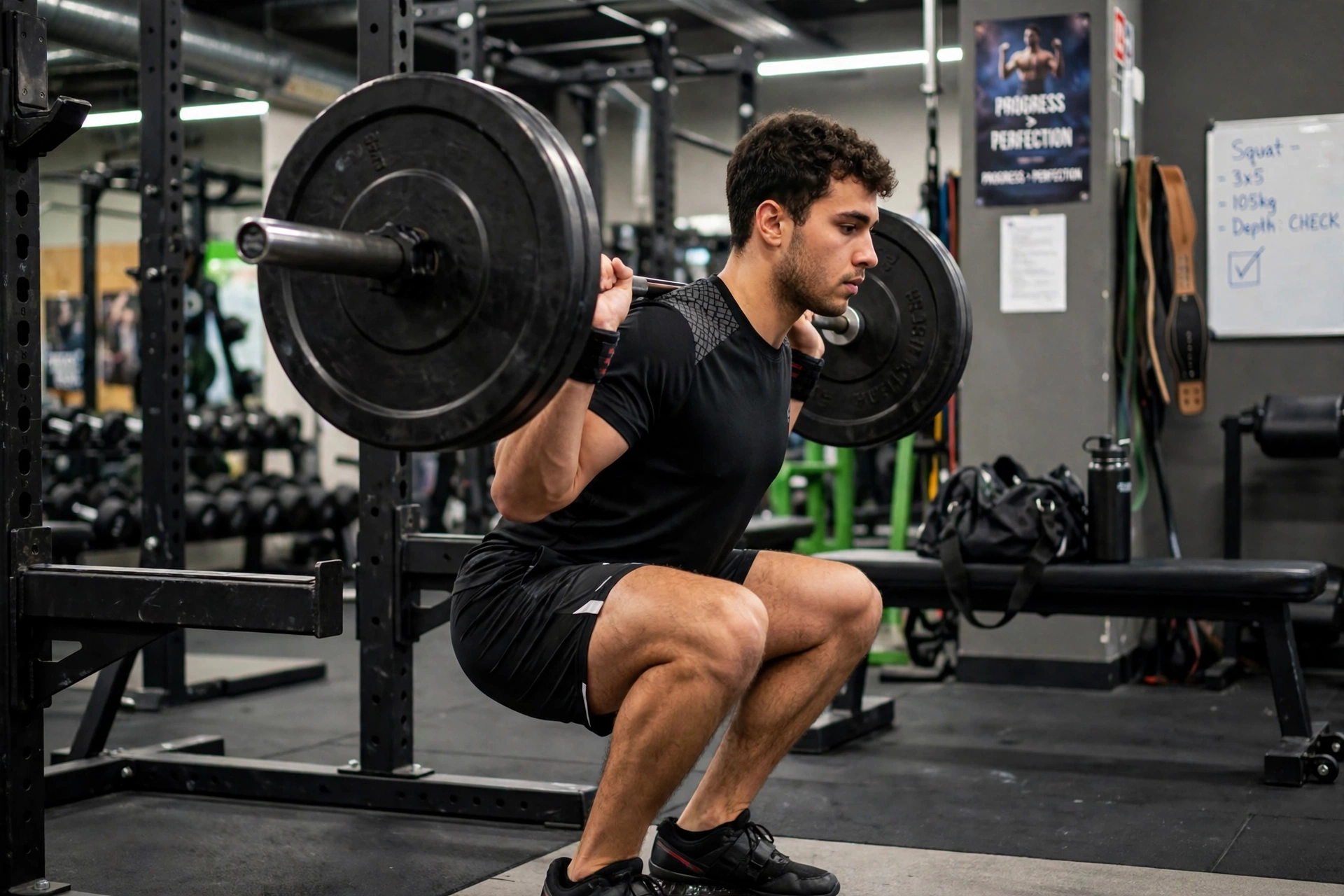
One that hits depth: hip crease below the top of your knee. That’s the powerlifting standard, and it’s the only standard that makes estimates comparable. A “rep” that stops four inches high isn’t a rep — it’s a rumor. The calculator can’t see your depth, so it will happily turn a set of high quarter-squats into a heroic max that doesn’t exist.
I’ve watched lifters “estimate” 405 off sets that wouldn’t pass in any federation on earth. Then they load 405, sink to actual depth, and get stapled. Film your test set from the side. Most people are surprised by what they see, and the surprise is never in the flattering direction.
How much does depth change the estimate?
A lot — it’s the single biggest variable in squat estimation. An ass-to-grass squat typically costs around 5% compared to a just-below-parallel squat, and a half-squat can handle dramatically more weight than either. These are working estimates from coaching consensus, not lab measurements, but the direction is undisputed: deeper costs pounds.
The practical rule: only compare estimates done to the same depth. If your test set was ATG and your training is to parallel, you’re mixing two different lifts and the number is meaningless. Pick the depth you’ll actually train and test at, then never deviate.
High-bar or low-bar — which number is my real squat?
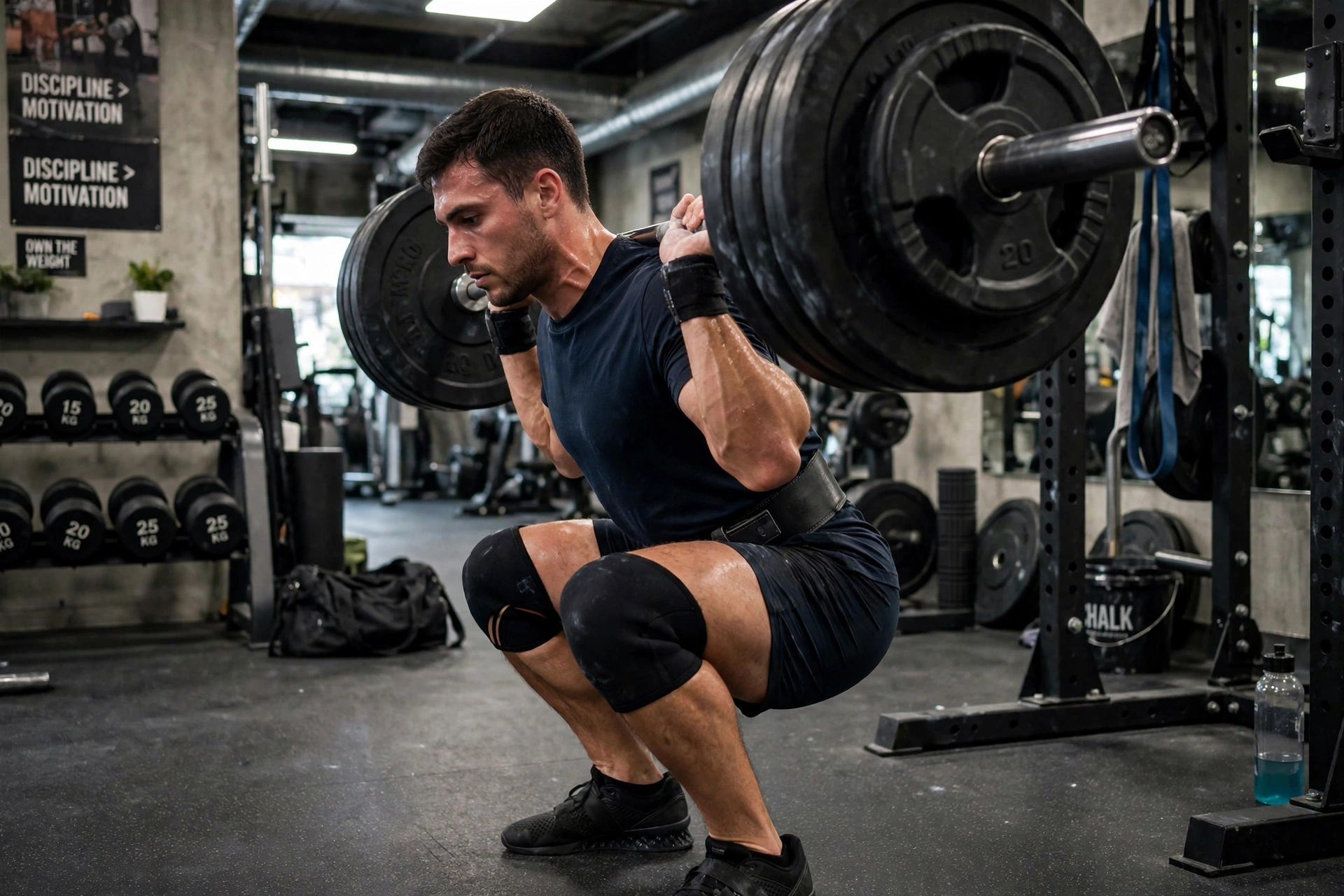
Both are real. They’re just different lifts. The low-bar position — bar sitting across the rear delts instead of on the traps — typically lets you move around 4% more thanks to better leverage and a shorter moment arm at the hip. A 300-lb high-bar squatter might low-bar 312 without getting any stronger.
This matters for estimation because the formulas don’t know where the bar sits. Feed a high-bar set into the calculator and use the result to plan low-bar training, and your percentages will be off by that 4% from day one. Track each position as its own lift with its own estimate.
Should I wear a belt for the test set?
Test the way you’ll lift. A belt isn’t cheating — it gives your abs something to brace against, which usually adds pounds to the bar. But belted and unbelted are two different numbers, and swapping between them mid-cycle quietly corrupts your trend line.
My take: do your test sets the way you do your heavy work sets. If you belt up above 80%, belt the test set. If you train beltless, test beltless. Consistency beats optimization here.
What’s the best rep range for estimating a squat max?
Three to five reps, taken close to failure, with depth and bar position locked in. That range keeps you far enough from a true single to stay safe, and close enough that the formulas don’t have to extrapolate across a canyon.
Past 8-10 reps, squat estimates loosen up fast — not just from the math, but because high-rep squats become a breathing and bracing challenge as much as a strength test. A 20-rep set tells you about your lungs and your pain tolerance. It tells you almost nothing about your single.
Worked example: 275 lb × 5
Let’s run it with Epley: 1RM = 275 × (1 + 5 ÷ 30) = 275 × 1.1667 = 320.8 lb. Call it 321.
Brzycki gives 275 × 36 ÷ (37 − 5) = 275 × 1.125 = 309.4 lb. Notice the gap — eleven pounds between the two formulas on the same set. That’s not a bug; it’s the formulas disagreeing about how your strength curve bends. The honest move is to treat 309–321 as a range and program off the bottom of it, not the top.
And remember the conditions: that 321 assumes the five reps hit depth, used one bar position, and were genuinely close to failure. Change any of those and the number changes with it.
Why does my squat estimate swing so much week to week?
Because squats are the most systemically demanding lift you do. Your estimated max can swing 5 to 8% across a single week — sleep, food, stress, and accumulated fatigue all move it. A 320 estimate on Monday can read 300 on Friday after a hard week, and neither number is “wrong.”
This is why you track the trend, not the data point. Log every estimate for a month and look at the direction of the line. A lifter whose estimates drift from 300 to 320 over eight weeks got stronger. A lifter obsessing over Tuesday’s dip versus Monday’s peak is reading noise.
One more thing that steadies the number: standardize everything. Same depth, same bar position, same belt call, same time of day if you can manage it. The calculator is precise; your inputs are the variable part. Control what you can.
Frequently Asked Questions
Can I estimate my squat 1RM from leg press numbers?
No — not with any formula. The leg press removes balance, bracing, and spinal loading entirely, so the strength curve is completely different. A 700-lb leg press might belong to a 315-lb squatter or a 405-lb squatter. If you want a squat estimate, you have to squat.
Does the calculator work for front squats?
The math works, but keep front squat estimates strictly separate from back squat. Front squats typically run 80–85% of back squat for the same lifter, and the limiting factor is often upper-back strength rather than leg strength. One lift, one estimate, one trend line.
How often should I retest my squat max?
For a true tested single: a few times a year at most, usually at the end of a training block or before a meet. For estimates: recalculate whenever you hit a strong 3-to-5 rep set in normal training. The estimate is free information — the test costs recovery.
Why is my estimated squat higher than what I can actually hit?
Almost always one of three things: the test reps were high, the bar position changed, or the set wasn’t as close to failure as it felt. Depth is the usual suspect — retest to a filmed, verified depth and the estimate usually drops to something you can actually stand up with.
Should beginners use a squat 1RM calculator?
For programming, yes — it’s safer than maxing out. For ego, no. A beginner’s technique changes fast enough that any estimate has a short shelf life. Use it to set training weights, retest the estimate monthly, and don’t get attached to the number.
Sources
- LeSuer, D.A. et al. (1997). The accuracy of prediction equations for estimating 1-RM performance in the bench press, squat, and deadlift. Journal of Strength and Conditioning Research, 11(4), 211–213.
Learn more