How to Estimate Your 1RM Without Maxing Out
You don’t need a true one-rep max to know your max. A heavy set of 3–5 reps through the Epley formula (weight × (1 + reps/30)) estimates your 1RM within a few percent — close enough to program off — with far less risk. For beginners, in-season athletes, and solo lifters, it’s the smarter way to get the number.
Why Would You Skip Max Testing?
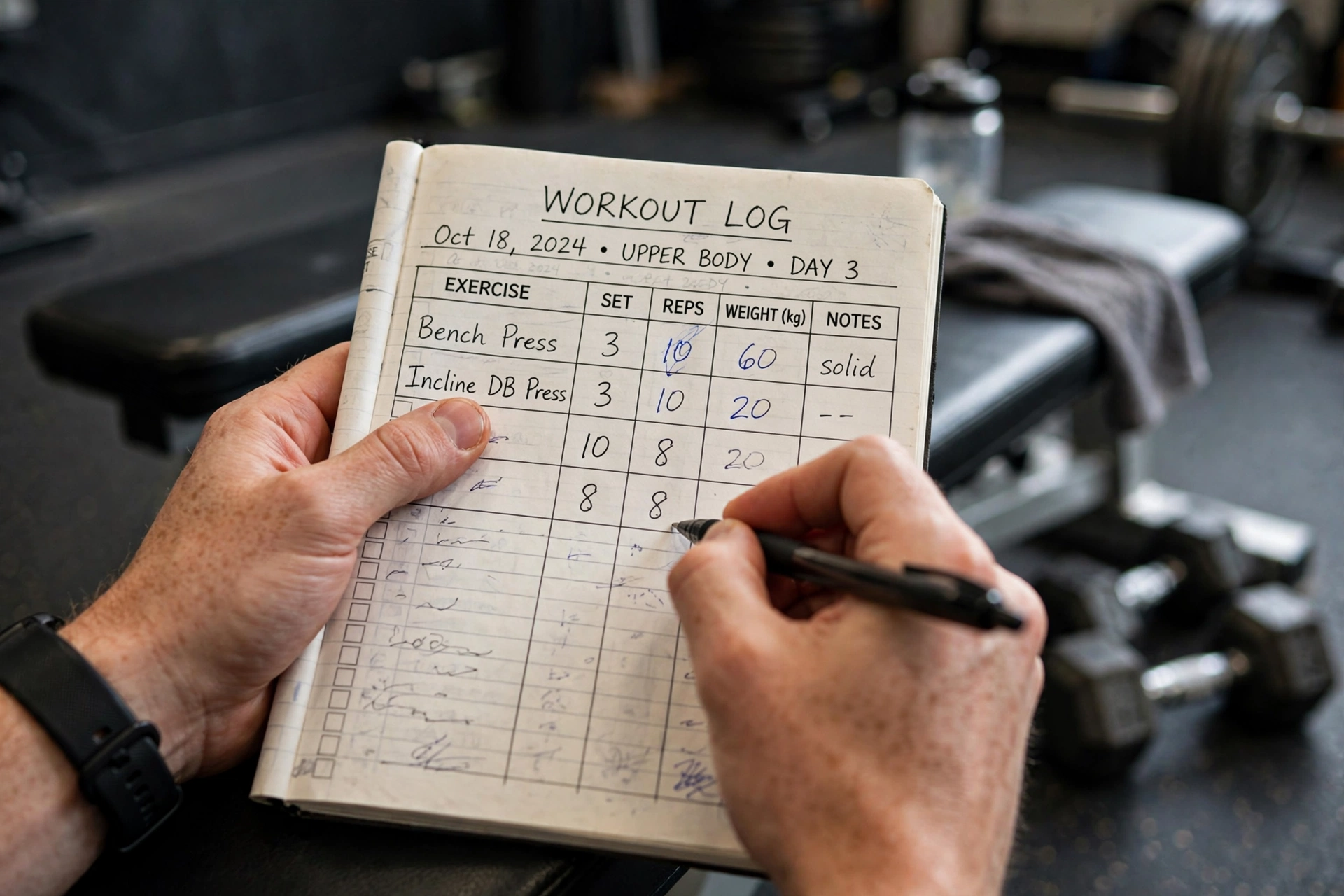
True 1RM testing is a skill and a stressor. It demands perfect warm-ups, spotters, and a willingness to grind a weight that might staple you. That’s a reasonable trade for a competitive powerlifter peaking for a meet. It’s a bad trade for a beginner whose technique isn’t stable yet, an athlete mid-season who can’t afford to be wrecked for a week, or a garage lifter training alone without safeties.
The deeper point: you don’t need a perfect max, you need a useful max. Programming runs off 85–90% of your max anyway, so a 3% estimation error changes your working weights by a couple of pounds — noise. What you need is a number that’s honest, recent, and didn’t cost you a training week to obtain.
What Is the 3–5RM Method?
Work up to a heavy set of 3 to 5 reps — the most weight you can lift for that rep count with solid form — then convert it with the Epley formula: 1RM = weight × (1 + reps/30).
Why 3–5 reps and not 10 or 12? Because prediction accuracy decays as reps climb. LeSuer et al. (1997) found formulas most reliable at 10 reps and under, and every coach who’s watched lifters knows the estimates get optimistic fast past 8 reps — high-rep sets measure work capacity as much as maximal strength. Three to five reps sits in the sweet spot: heavy enough to reflect true strength, light enough to be safe.
Worked Example
You work up to 200 lb × 5 on the squat — a genuine 5-rep max, good depth, no grinder that took ten seconds.
Epley: 200 × (1 + 5/30) = 200 × 1.1667 = 233 lb estimated 1RM.
Now build your training max (90%, per Wendler): 233 × 0.9 = 210 lb. Every percentage in your program comes off 210. You got a fully usable programming number from a set that took thirty seconds and left you fresh enough to keep training.
How to Run the 5RM Test Day
- Warm up thoroughly — the full ladder (bar × 10, 50% × 8, 60% × 5, 70% × 3, 80% × 1, 90% × 1 of your target).
- Take 2–3 attempts at your 5RM, resting 3–5 minutes between. First attempt conservative, second at your goal, third only if the second moved well.
- Stop when form breaks or the bar speed collapses. A 5RM with ugly reps isn’t a 5RM — it’s an injury audition.
What Is the RIR Method?
Don’t even go to a rep max. Take a heavy AMRAP-style set, stop with 2–3 reps in reserve (RIR), and estimate from there: treat the reps you did plus the reps you left as your rep count in the formula.
Example: you squat 185 × 6 and stop confident you had 2 more — that’s an estimated 8RM. Epley: 185 × (1 + 8/30) = 185 × 1.2667 = 234 lb.
This is the gentlest method on the list. You never approach failure, never need a spotter hovering, and you can do it inside a normal training session instead of dedicating a test day. The trade-off is honesty: the method is only as good as your RIR judgment, and most lifters overestimate reps-in-reserve until they’ve calibrated (trained lifters get within about ±1 rep on bench, per Refalo et al. 2023 — beginners are worse).
What About Velocity-Based Estimation?
Velocity-based training (VBT) estimates your 1RM from bar speed: you lift submaximal weights with a velocity tracker, and the device extrapolates where your speed would hit your known minimum-velocity threshold — the speed at which you’d grind out a true max. It’s genuinely clever and genuinely accurate in the right hands.
The honest caveats: a reliable velocity tracker costs real money, the method needs your personal load-velocity profile built over multiple sessions, and a 2024 meta-analysis (LeMense et al.) found velocity-based estimates can overestimate squat 1RM. For most lifters, it’s a luxury — the 5RM method gets you 95% of the answer for free. Consider VBT if you’re a competitive lifter or a data enthusiast, not if you just need a programming number.
Which Method Should You Use?
| Method | Best for | Accuracy | Risk |
|---|---|---|---|
| 5RM + Epley | Most lifters, most of the time | High (±3–5%) | Low–moderate |
| RIR estimate | Beginners, in-season athletes, solo lifters | Moderate (depends on your RIR honesty) | Very low |
| True 1RM test | Competitors peaking for a meet | Exact (it is the max) | Highest |
| Velocity-based | Data-driven competitors with the gear | High (with a good profile) | Low |
My default recommendation: the 5RM method, retested every 6–8 weeks, feeding a 90% training max. It gives you everything a program needs and costs you one heavy set. Save true maxing for when there’s a platform, a judge, and a reason.
What Are the Accuracy Trade-Offs?
Every estimation method trades a little precision for a lot of safety, and the trade is overwhelmingly worth it. A 5RM-based estimate might be 3–5% off your true max — but remember what the number is for. Your heavy triples run at 85–90% of it. A 4% error on a 233 max shifts your working weight by about 8 lb, which is less than daily strength fluctuation anyway.
The real accuracy killer isn’t the formula, it’s the input. A sloppy 5RM with cut depth and a ten-second grinder produces a fantasy number no formula can fix. Test honestly — full range of motion, reps you’d count in competition — and any of these methods gives you a number you can trust enough to train off.
Frequently Asked Questions
How accurate is the 5RM-to-1RM estimate?
Within about 3–5% for most lifters when the 5RM is honest. Formulas are most reliable at 10 reps and under (LeSuer et al. 1997), and 5 reps sits comfortably inside that window.
Can beginners estimate 1RM this way?
Yes — and they should prefer it over maxing. A beginner’s true 1RM is mostly a technique test anyway; a 5RM estimate is safer and arguably more representative of their trainable strength.
Why not just use a 10RM? It’s even safer.
Because accuracy falls off as reps rise. A 10-rep set measures muscular endurance as much as maximal strength, and the formula starts crediting you for engine instead of horsepower. Five is the sweet spot; eight is the practical ceiling.
Do I need to retest often?
Every 6–8 weeks is plenty. Between tests, track your top sets — if last cycle’s 5RM weight is now moving for 7, your estimated max has gone up and you can nudge the training max without a formal test.
Is the RIR method too subjective to trust?
For programming, no — as long as you’re conservative. If you think you had 2 left, program as if you had 1. The built-in 90% training max absorbs the remaining error. It beats maxing alone in a garage every time.