
1RM by Lift: Bench, Squat, Deadlift & Overhead Press
Your one-rep max belongs to one lift and one lift only. Your bench estimate says nothing about your squat, and your deadlift number won’t predict your press. Below is how to estimate your 1RM for the bench press, squat, deadlift, and overhead press — what changes for each lift, where the formulas get shaky, and how to get a number you can actually train off.
Why doesn’t my 1RM transfer between lifts?
Because they’re different movements that ask different things of your body. Your squat uses the biggest muscles you’ve got. Your bench uses a fraction of that mass. Your deadlift starts from a dead stop with no stretch reflex to help. The leverages, the technique, the neurological demand — none of it carries over in any fixed ratio.
I’ve seen lifters with a 400-lb deadlift and a 225-lb bench. I’ve seen the reverse shape too — big pressers who can’t pull. Limb length alone scrambles everything: long arms are a curse on the bench and a gift on the deadlift. No formula knows your arm length. That’s why every estimate has to be built from a set you performed, on that lift, with your technique. Borrow someone else’s ratio and you’re guessing twice.
The practical rule is simple: one lift, one test set, one estimate. Never convert between lifts with math. If you want your squat max, squat something heavy and plug that in.
How do I estimate my bench press 1RM?
The bench is where calculators get the most arguments started, because small technique differences move the number a lot. Three things matter more than people think.
Paused vs. touch-and-go. A paused rep — bar motionless on the chest for a beat — typically runs about 95% of a touch-and-go max for most lifters. That’s community consensus, not lab science, but it holds up surprisingly well. The calculator doesn’t know which one you did, so enter what you actually performed. If you compete in powerlifting, test paused. It predicts your platform number far better than bouncy gym reps.
Bouncing. If the bar rebounds off your ribcage, the stretch reflex just donated reps your pressing muscles didn’t earn. The estimate comes back inflated and you’ll find out the truth the first time you try to pause that weight. Touch the chest under control. Every rep.
Arch. A moderate arch is legitimate — it puts your shoulders in a safer position — but it shortens the bar path. A big arch plus high reps is the classic recipe for an estimate that looks heroic on screen and humiliating under the bar.
For the tightest bench estimate, use a 3–5 rep set, taken close to failure, with the same setup you’d use on a heavy single. Touch-and-go or paused — just don’t mix them. Then run it through the bench press calculator and compare Epley against Brzycki instead of trusting one alone. At 225 lb for 5 reps, Epley says 262.5 and Brzycki says 253.1 — that gap is honest information, not a bug.
How do I estimate my squat 1RM?
Depth is everything on the squat. It’s also the thing people lie to themselves about most.
A squat to parallel and an ass-to-grass squat are different lifts wearing the same name. Going full depth typically costs around 5% compared to a just-below-parallel squat, and a half-squat can handle dramatically more — which is why “I squat 405” means nothing until you know how deep. The standard that counts: hip crease below the top of the knee. If your test set didn’t hit depth, your estimate is fiction. Film a set from the side if you’re not sure. Most people are surprised.
High-bar vs. low-bar is the other split. Low-bar position typically lets you move around 4% more thanks to better leverage, but again — different lift, different number. Track them separately and never feed a high-bar set into an estimate you’re going to use for low-bar training.
Belt or no belt changes the number too. A belt improves bracing and usually adds pounds to the bar. Neither choice is wrong, but pick the one that matches how you’ll actually train and test that way every time.
Squat estimates also swing more day to day than bench — 5 to 8% across a week is normal. Don’t marry a single number. Run your squat estimate from a 3–5 rep set, write it down, and watch the trend over a month. The trend is the truth; any single estimate is a snapshot.
How do I estimate my deadlift 1RM?
The deadlift is the lift calculators understand worst, and there’s published research saying exactly that. LeSuer and colleagues tested seven prediction equations back in 1997 and found that every single one underestimated the deadlift by 9–14%. Your real pull almost certainly runs above whatever the math spits out. Keep that in your pocket before you let a calculator talk you out of an attempt you’re ready for.
Grip is the hidden variable. I’ve watched lifters pull 500 for five whose hands gave out at 540 for a single. The formula sees “500 × 5” and predicts a max your back could hit but your hands can’t. If grip is your limiter, the estimate is really estimating your grip. Test without straps if you want the honest number; train with them if your program calls for it — just know which number is which.
Dead-stop vs. touch-and-go matters more here than anywhere. A true deadlift starts from a dead stop — that’s the lift’s whole identity. Touch-and-go reps borrow the stretch reflex and inflate the count. Reset each rep without letting go of the bar and you’ll get an estimate that actually predicts a real pull.
Keep the reps low. Three to six clean reps is the sweet spot for deadlift. Go much past eight and your cardiovascular system starts failing before your muscles do — now you’re measuring conditioning, not strength, and the estimate drifts. Plug a crisp triple into the deadlift max calculator, expect the real thing to run a touch higher, and you’ll rarely be surprised.
What about overhead press 1RM?
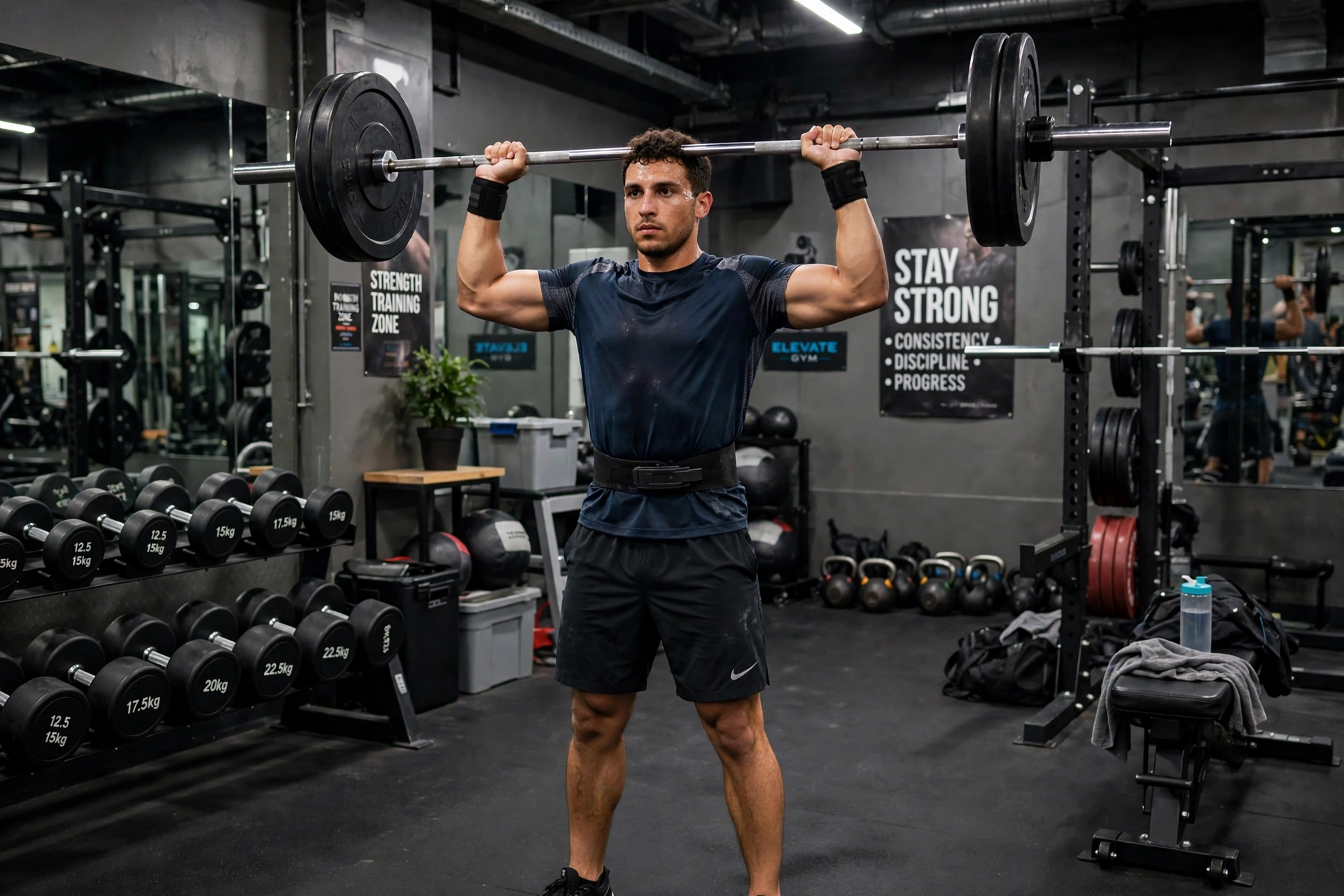
The press is the forgotten lift in most 1RM discussions, which is a shame because it’s the purest upper-body strength test you’ve got — no bench to lie on, no leg drive to hide behind. Or rather, there shouldn’t be.
Strict vs. push press are two different lifts. The moment your knees bend, it’s a push press, and the number jumps — sometimes by a lot. There’s no fixed conversion because it depends entirely on how good your leg drive is. Decide which lift you’re estimating and be ruthless about the standard. A “strict press” with a knee dip on rep four is a push press set with a strict press label, and the estimate will know even if you won’t admit it.
One more thing about the press: the muscles involved are smaller, which means estimates swing more than they do on the big three. A 5-rep set predicts better than an 8-rep set here, even more so than usual. And micro-loading matters — when your max is 135, a 5-lb jump is nearly 4%, so round your training weights with more care than you would on a 400-lb deadlift.
Which formula should I use for each lift?
Honestly? More than one. Epley (1985) and Brzycki (1993) are the two workhorses — they’re identical at exactly 10 reps and diverge everywhere else — and comparing them tells you more than either one alone. If they land within a few pounds of each other, you’ve got a number worth trusting. If they spread wide, your rep count was probably too high, and that’s useful information too.
The 5-rep set is the sweet spot across all four lifts. Reynolds and colleagues showed back in 2006 that 5RM-based predictions were the most accurate in their testing, and two decades of gym-floor experience haven’t argued with that. Five heavy, clean, consistent reps — that’s the input that makes every formula behave. Our full formula comparison walks through all seven equations with the math shown.
Frequently Asked Questions
Can I use my bench 1RM to predict my squat?
No — not with any reliability. Lifters’ bench-to-squat ratios scatter all over the place depending on leverages, training history, and body structure. The only honest way to know your squat max is to squat something heavy and estimate from that set.
Should I test paused or touch-and-go bench?
Test the way you’ll compete or train. Paused reps predict a competition max better; touch-and-go is fine for gym programming. Just never mix them — a paused test set and a touch-and-go estimate are different numbers, about 5% apart.
Why is my deadlift estimate always low?
Because the formulas genuinely underpredict the deadlift — LeSuer et al. (1997) measured a 9–14% underestimation across all seven equations they tested. Add grip as an unmeasured limiter and most lifters pull above their calculated max. Treat the estimate as a floor, not a ceiling.
Does sumo vs. conventional change my deadlift 1RM?
They’re different lifts with different leverage demands, so yes — most lifters pull slightly different numbers in each stance. Estimate from the stance you actually train. Don’t convert between them.
Can I use these calculators for dumbbell lifts?
Yes, with one rule: be consistent about what you enter. For two-dumbbell lifts, enter the combined weight of both. For single-arm work, enter the single dumbbell. The formulas don’t care what you’re holding, only that you measure the same way every time.
Sources
- LeSuer, D.A., et al. (1997). The accuracy of prediction equations for estimating 1-RM performance in the bench press, squat, and deadlift. Journal of Strength and Conditioning Research, 11(4), 211–213. https://doi.org/10.1519/R-17094.1